

Broken Promises: Energy
Big statements, no specifics, poor results
Greetings from Wittman Watch HQ! 👊
Early in-person voting for the VA-01 primary is open, and will go through August 1. You’ll find all the info you need to cast your ballot here.
📣 Special announcement! Our community of Wittman Watchers has asked for ways to spread the word about Wittman. Sharing our content and newsletter are great — and now you can do it in style! Check out the Wittman Watch store for hats, shirts, yard flags, and accessories that let you show you’re a Wittman Watcher, and share a QR code to our site. As usual, we make $0 — it’s just a stylish, fun way to get friends and neighbors to watch Wittman with you.

Last Thursday we took a look at Rob Wittman and the seven deadly sins. If he can’t do good, at least he should do better.
On Tuesday we opened the Wittman Truth File on earned benefits. WTFs are great for sharing with friends, neighbors, and anyone you know who might benefit from never voting for Wittman again. (That would be everyone.)
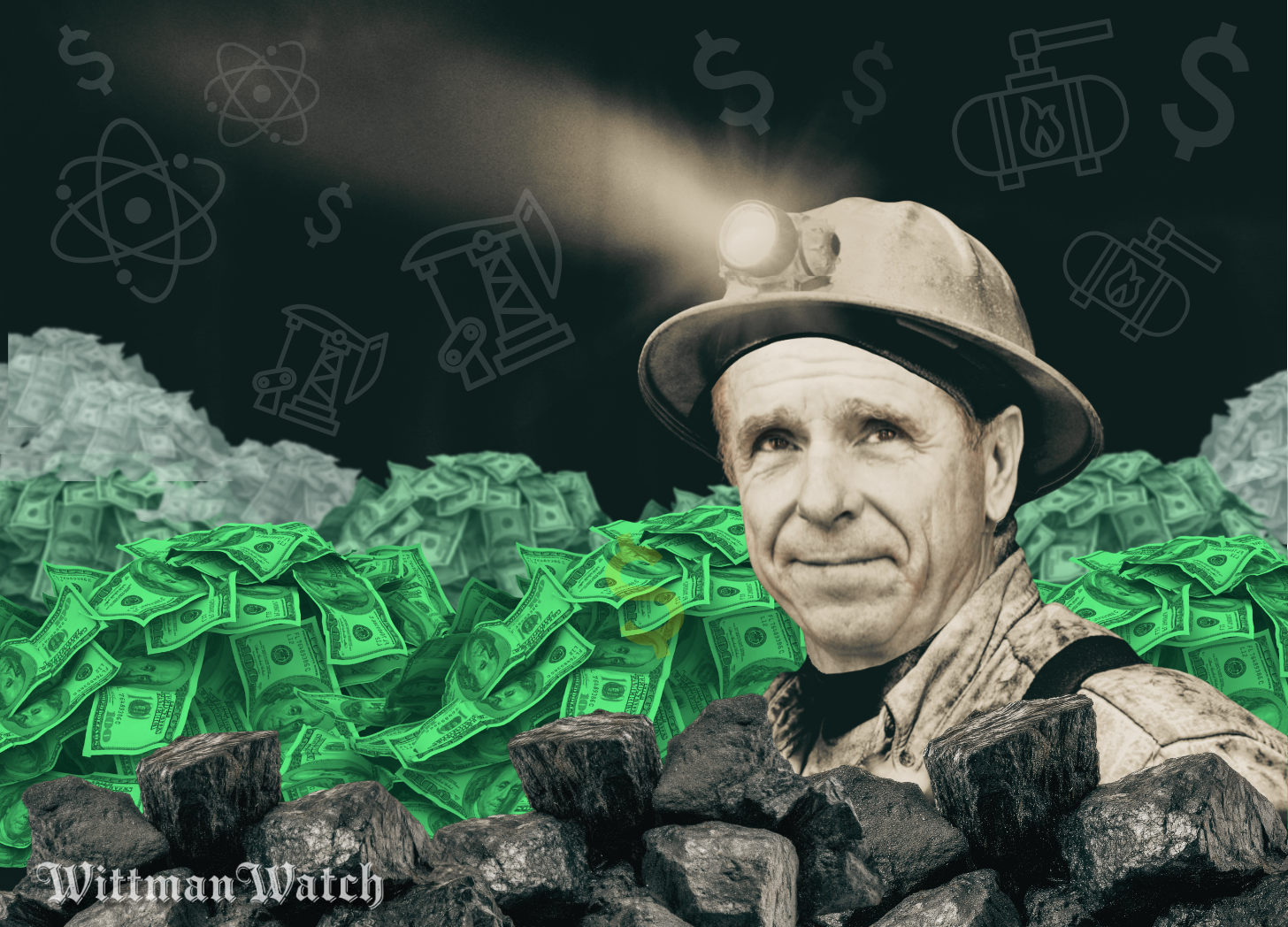
Since Rob Wittman first ran for Congress in December 2007, he has included energy policy in his campaign platform. For 19 years, he has promised VA-01 energy abundance and independence—but did he deliver on it? Are we best served by continued reliance on fossil fuels, or has Wittman sabotaged our ability to benefit from renewable energies like wind and solar?
Archived pages on the Wayback Machine (via Internet Archive) of Wittman’s campaign websites plus his actual legislative record reveal his story of campaign energy promises in three distinct acts:
The National Security Era (2007–2016) – Wittman framed America’s oil dependence as a terrorism problem requiring urgent action
The Silent Era (2018) – Blink and you’ll miss his scant energy policy
The Clean Energy Rebrand (2020–2024) – Previous energy policy commitments returned dressed up in new vocabulary such as “innovation,” “carbon capture,” and “greenhouse gas emissions”
We now present Wittman’s campaign pledges to deliver energy independence and abundance, along with the themes and patterns that shaped his pledges over time. This is the record as Wittman himself presented it.
2007 — Terrorism, oil, and vague solutions
Wittman framed America’s energy dependence as a national security crisis. For context, oil was climbing toward $100 a barrel during the Iraq War. Terrorism made for politically strategic messaging. Under “Working for Energy Independence,” he declared that protecting national security and energy independence are linked. America’s dependence on foreign oil, he wrote, “has led us to do business with governments that support and fund terrorism, and this must be stopped.” His proposed solution, an “all options” posture, involved “aggressive exploring” of both domestic and alternative energy sources, which would “keep more of our energy dollars” in America while “reducing the power of terrorist regimes.”
Wittman talked a big game with these pledges, but cited no specific technologies, legislation, or dollar figures to turn them into action. His pledges also didn’t account for environmental protection, climate change, alternative energy sources, or domestic energy resources. He was making a statement on values, not outlining a concrete policy blueprint. Wittman’s first energy promise was to solve a problem he defined in moral terms yet offered no mechanism to solve it. In retrospect, that was the start of a pattern.
2008 — No new energy promises
Wittman’s archived 2008 campaign site contains no new energy policy statements. Given that 2008 was the year oil prices reached a historic high of $147 per barrel and energy dominated the national political conversation, the absence of them is notable. Whether this reflects an incomplete archive or a deliberate choice by Wittman (fossil fuel dominance equals mission accomplished?), we couldn’t find any new energy pledges on record for that year.
2010 — The “all of the above” era begins
By the end of Wittman’s first full term, his national security framing remained unchanged, but his energy platform now included an “all of the above” strategy to increase domestic energy exploration, including wind, solar, hydro, biomass, geothermal, and nuclear. He became a proponent of offshore energy development so long as it was achieved “in an environmentally friendly manner.” He also linked the expansion of alternative energy sources to “high paying jobs in Virginia.” Wittman pledged to return gas pump tax revenues paid by Virginians back to the state. He also framed telework as an energy-saving strategy that would “keep folks off the already crowded roads.”
In sum, Wittman used disingenuously worded pledges to claim credit for solar and wind energy projects while continuing to champion offshore drilling and oil shale extraction. Nor did he elaborate on what he meant by conducting offshore energy extraction in an “environmentally friendly manner.”
2012 — Copy, paste, repeat
Wittman’s 2012 energy campaign platform was identical to his previous one. At the same time, the national energy landscape between 2010 and 2012 was anything but static: the shale boom was accelerating, offshore deepwater drilling led to the Deepwater Horizon disaster, and solar panel prices had dropped by as much as 14%. Yet Wittman’s campaign website reflected none of it.
During this term, he introduced The Advancing Offshore Wind Production Act (H. R. 1398), but it failed in the Senate. After four years in Congress, including a seat on the Natural Resources Committee, Wittman’s pattern conveys that energy is a checkbox for him, not a priority.
2014 — The most aggressive energy platform on record
In 2014, Wittman put his energy policy into his “Jobs for Virginians” section, claiming credit for “creating thousands of jobs.” Specific legislation appeared for the first time. Wittman described being a lead co-sponsor of the Offshore Energy and Jobs Act (H. R. 2231), which required the Secretary of the Interior to develop a new 5-year oil and gas leasing program and mandated three specific Outer Continental Shelf lease sales off Virginia’s coast. He also voted for the Federal Lands Jobs and Energy Security Act (H. R. 1965), aimed at expanding onshore energy production and streamlining the permit process. Both bills expanded fossil fuel extraction — offshore and on federal lands, although neither advanced to become laws.
This was Wittman’s most energy-aggressive campaign platform so far. But despite the way he baked fossil fuel and renewable energy into one big pie, his “all of the above” stance and his two cited bills provided cover for his fossil fuel expansion votes. He promised to support energy independence and abundance, but only delivered votes that served Big Oil.
2016 — Same bills, new election
Wittman’s 2016 energy platform repeats the one from 2014 — including the same two legislative citations, H. R. 2231 and H. R. 1965. Although they hadn’t advanced to laws, he cited their existence as achievements, for a veneer of accomplishment. The Paris Agreement was signed in April 2016; solar prices had dropped since 2010; and the scientific consensus on climate change had never been stronger. Was Wittman living under a rock? His campaign promises included zero awareness of energy-related current events. By citing dead legislation, he gave the appearance of specificity without the substance of it, thus evading accountability.
2018 — The year energy disappeared
Wittman’s energy policy ideas appeared in every campaign platform since 2007, but seemed to vanish in 2018. This smacks of silent complicity, because during that time the Trump administration was rolling back Obama-era energy and climate regulations, to the detriment of places like the Chesapeake Bay and James River.
Supporting Trump’s Big Oil energy policies made it hard for Wittman to position himself as a champion of the environment to his constituents. Rather than taking meaningful steps to resolve this tension, Wittman quietly removed his energy policy pledges from his campaign website and hoped no one noticed.
2020 — The clean energy rebrand
Wittman rebranded his energy pledges with sparkly new language. For example, “Working for Energy Independence” became a subsection of “Environment and Energy.” Gone was the terrorism framing, oil shale, biomass and geothermal, which were replaced with terms like “carbon capture” and “greenhouse gas emissions.” His energy list included natural gas, nuclear power, hydropower, wind, and solar, yet didn’t draw a distinction between natural gas and zero-carbon sources on the grounds of climate impact.
Wittman cited his (largely inconsequential) support for the “permanently reauthorized…Land and Water Conservation Fund, which channels royalty revenue the federal government receives from offshore oil and gas projects into conservation projects.” That’s hardly a statement of past or future action. Then he cited his membership in the House Renewable Energy Caucus as if to impress us with his “credential” of knowing that investing in “clean, reliable” energy is “a great place to start” protecting the environment.
His campaign pledge shifted from the seriousness of national security to the optimism of innovation, stating that “The United States is already leading the world in reducing greenhouse gas emissions through innovation and technological development.” His focus also turned to removing barriers to new technology rather than new regulations.
Despite Wittman’s marketing rebrand, the actual list of energy sources he supported barely changed. But the language did — natural gas remained, now framed as “clean” energy. His claim that America is “already leading the world” in emissions reduction is the kind of reassurance that makes additional legislation feel unnecessary — which may have been exactly his point. This messaging essentially let Wittman off the hook by implying the problem was being managed, so major new action on his part was unnecessary.
2022 — A focus on energy independence and affordability
Wittman’s campaign platform formalized his 2020 clean energy reframe. Energy takes center stage in the environment section for the first time since 2016. He pledged to support the same energy sources as before; parroted his previous statement about the U.S. leading the world in greenhouse gas emission reduction; and reiterated his support for the Land and Water Conservation Fund. He again emphasized harnessing domestic “all of the above” energy sources to keep America energy-independent.
Two new pledges surfaced: a consumer-oriented promise that involves “lowering the cost for hardworking families” and protecting the environment without “expense to jobs, prosperity, and national security.” These were a departure from his theme of threats to America’s energy sources from hostile regimes, likely because gas prices hit record highs during the Biden administration — and because Wittman must have been aware that the GOP tried to make us believe they never went back down.
In 2022, Wittman invoked energy independence, affordability, clean energy, and national security all in one section — while still touting natural gas as clean and reliable. “Affordable and reliable energy” is a popular position because no one campaigns for expensive, unreliable energy. What Wittman’s campaign promises lacked was specific, concrete legislative strategies. How will energy become more affordable? What policy would he propose to reduce costs for things like his constituents’ heating bills? His platform didn’t say, rendering his promises hollow and worthless.
2024 — The push for nuclear power
Wittman’s platform in 2024 followed the previous two campaign templates, but introduced one significant new element under “Natural Resources: Energy”: the 21st Century American Atomic Energy Age Act (H. R. 3553). Wittman described his bill as unleashing “the full potential of nuclear power and pav[ing] the way for a prosperous, secure, and energy-independent future.” For context, back in 2023, he supported former Governor Youngkin’s proposal for Virginia to build America’s “first commercial, next-generation small modular reactor.” Nuclear power plants like Small Modular Reactors (SMRs) are unproven technology that will take years to build.
In 2024, as part of his role on the House Armed Services Committee, Wittman asked “for more procurement for nuclear micro-reactors” to “ease the logistics of powering forward bases.” But such projects take time, and as of Wittman’s request, the Pentagon was only at the planning stage regarding testing nuclear microreactors “in the near future.” Wittman is nothing if not consistent in his unrealistic energy goals.
H. R. 3553 is the most concrete new energy commitment in Wittman’s legislative record and campaign platform since his Offshore Energy and Jobs Act of 2014. Why, after over a decade of including nuclear energy pledges during his re-election campaigns, did he introduce this legislation in 2024? Perhaps it had something to do with his desire to build data centers on naval bases. Ramping up data center development hasn’t always been a boon for consumers, but we know Wittman stands to benefit personally from his energy investments. Who does Wittman serve, his constituents or Big Tech?
2026 — Lather, rinse, repeat
As part of his 2026 re-election campaign, Wittman promises us:
An “all-of-the-above” approach to energy investment (including dirty fossil fuels that ruin our lands and keep us dependent on foreign oil)
Domestic energy independence (which could lead to oil drilling in wildlife habitats)
Clean energy (despite voting to eliminate clean-energy tax credits)
Energy production linked to affordability, jobs, and national security (even though he voted to increase costs, slash jobs, and keep the Iran War going)
The 21st Century American Atomic Energy Age Act (H. R. 3553) (but at what risk?)
“The U.S. leads the world in greenhouse gas emissions” (but electricity prices didn’t decline after former Governor Youngkin yanked Virginia out of the Regional Greenhouse Gas Initiative)
Pie-crust promises: easily made, easily broken
During his re-election campaigns, Wittman has routinely promised an abundance of energy from a multitude of sources, along with related benefits such as jobs. His campaign pledges always sound grand but contain little in the way of actionable strategies or results. And when he has legislated, he has supported fossil-fuel-friendly bills that would prop up smog-belching power plant relics and increase our utility bills; voted to eliminate clean-energy tax credits; and favored “Drill Baby Drill” policies, such as the kind that temporarily stabilized coal in southwest Virginia, created no new jobs, and didn’t lower energy prices.
Several themes emerge from his ever-evolving energy campaign promises. These deserve close scrutiny as we head toward the 2026 Congressional midterm election:
A shifting focus from national security as the rationale for energy independence to a rationale of innovation and cutting red tape
Natural gas is a permanent guest in his campaign pledges
Promises of offshore drilling that peak and wane with the political winds
Nuclear energy at first absent, but later an anchor of his energy promises
Campaign promises recycled from one election to the next, even when action on these promises was neither attempted nor accomplished
Consistent avoidance of any acknowledgement of climate change
Energy development framed in terms of fostering jobs for VA-01, while Wittman votes to cut civilian federal jobs
Hollow promises of conservation funding despite its fossil fuel costs
Empty promises of affordable, reliable energy, with no clear mechanisms for delivering on that promise
These themes, especially in the past 10 years, reflect Wittman’s prioritization of Trump administration policies, loyalty to his big donors, and his drive to increase his personal wealth over his constituents’ needs.
Wittman has indeed delivered some results, but not necessarily the ones we expected or wanted:
The Iran War has caused a jump in crude oil prices — to as much as over $100 per barrel
The Iran War has inflicted direct and indirect costs on taxpayers
Data centers are driving up Virginians’ utility bills while lining Wittman’s pockets
Virginia consumers are at risk of paying more after the House passes federal rollbacks of “federal energy efficiency standards for appliances and equipment”
Wittman sits on the House Committee on Natural Resources and is a member of the House Renewable Energy and Energy Efficiency Caucus. Yet all told, he has sponsored a mere seven energy bills over his 19 years in Congress. Only two of Wittman’s bills became law.
We can’t change the past, but we can hold Wittman accountable now and in the future. The best way to accomplish that is to VOTE on November 4 for a representative who will strive to balance Virginia’s energy and economic needs with our quality of life in transparent, accountable ways. Meet seven options better than Rob Wittman.
To get the full picture on Rob Wittman, subscribe to this Substack (two emails a week, and we’ll never bombard your inbox about anything else) and any of our social media channels: Facebook, Instagram, BlueSky, or Reddit.
Great rant on how Congressman Wittman wants to maintain the fossil fuel status quo by keeping Virginians enslaved to dirty energy while destroying the environment.
Did you know that Virginia has hundreds of gas and oil “stripper wells”?
Many are in Wittman’s Tidewater/Piedmount region and are not only contaminating ground water but releasing large amounts of methane gas.
https://ft.maps.arcgis.com/apps/instant/sidebar/index.html?appid=0dc1ef990ec3413fb862267485d2567a
Biden had a program to reduce and/or cap this methane by Trump Republican and are actively reversing these environmental protections.
ProPublica has done an expose’ on this DEREGULATION and described here.
https://link.propublica.net/view/60c020a29a0b1045dc1e60d3rippl.1bqa/7a1cea9c