

Wittman is an environmental catastrophe
A marine scientist should know better
Greetings from Wittman Watch HQ!
Last week we wrote about how Wittman serves big donors instead of us.
State of the Race: On Tuesday we paused our Myth of the Week series to bring you an important Virginia election/redistricting update. (Myth of the Week will be back next week!)
You’ll find this week’s social media roundup here.
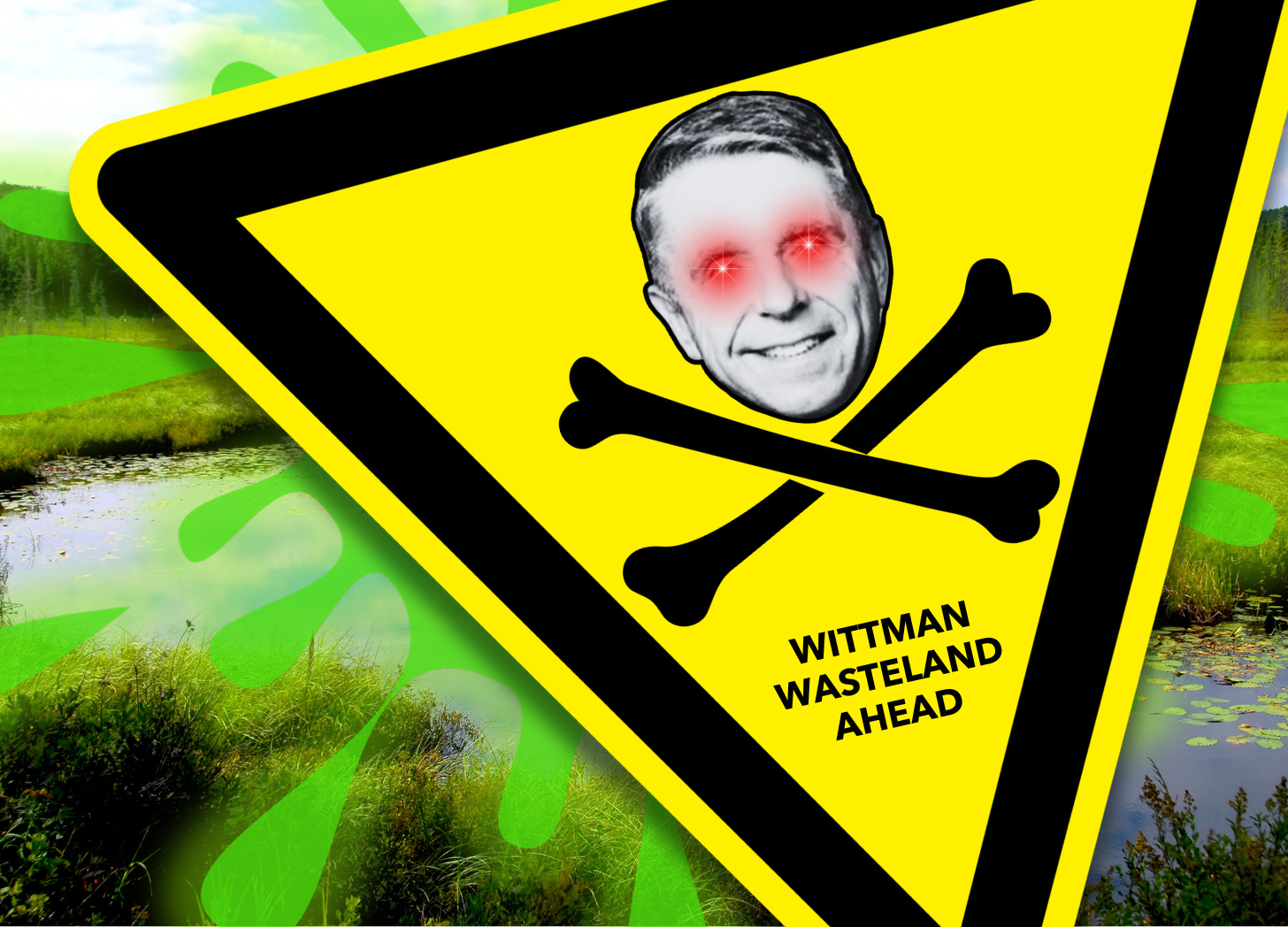
Virginia’s First District is rich in natural resources that benefit us all. Responsible and effective stewardship of these critical resources is a job for all of us — including and especially VA-01 Congressman Rob Wittman. Environmental damage over the decades suggests that we must all do better, particularly the elected officials who have influence and power. Every Virginian is entitled to a healthy community, environmental stability, and a sustainable future. What has Wittman done in service of those goals?
Virginia’s environment in and around VA-01
The Chesapeake Bay is the largest estuary in the country. Historically, it’s been plagued by pollution, habitat loss, and overfishing. The Chesapeake Bay Agreement of 1983 launched a decades-long restoration effort. In 2025, the governors of both Virginia and Maryland recommitted to the program. But the Trump Administration’s drastic budget cuts to the Environmental Protection Agency (EPA), deregulation efforts, and rollback of the Clean Water Act threaten the Bay anew.
Climate change has already affected Virginia; a 2025 Virginia Climate Assessment by the state’s scientists “warns of rising heat, worsening flooding and economic losses.” The storm surges, heat waves, and tidal flooding in our future will have the greatest impact on historically marginalized, economically vulnerable communities.
The James River is one of Virginia’s most prominent landmarks, yet its history of pollution has harmed Virginians’ health and reduced our life expectancy. Currently, dozens of commercial businesses — including Honeywell and AdvanSix — can legally dump waste into the James River. Farms and residential areas leak nitrogen and phosphorus into the waterways.
Wetlands are the natural and critical infrastructure of Virginia’s shorelines. The EPA loosened regulations on wetlands despite Virginia’s loss of wetlands happening sooner than expected. Legislation is desperately needed to help preserve our wetlands before we lose them permanently.
Data center dangers
Virginia is known as the data center capital of the world, and this comes at a staggering environmental cost. Even as these specialized facilities process the data we use in our daily lives, they harm our environment in multiple ways:
Air, water, and noise pollution
Damage to ecosystems
High resource demands (water and energy usage, land depletion)
Health risks from “forever chemicals” (PFAS)
Environmental injustice from data center concentration in low-income/historically marginalized communities
Data center companies may claim that they target rural areas for job creation purposes, but in reality it’s for the “lower construction costs, abundant land… network connectivity and access to reliable, affordable electricity.” The result is large-scale environmental damage and disruption of Virginia’s rural landscapes.
The Omega Protein problem
Wittman likes to pose with his bright yellow hard hat to fool us into thinking he’s protecting the Chesapeake Bay’s ecosystem along with Virginia’s economic interests. Don’t fall for his act. This poser ignores fish conservationists who have long been sounding the alarm about Omega Protein’s harmful fishing practices and damage to menhaden fish stocks.
He expresses no concern that the company is channeling profits to a Canadian company rather than Virginia. Why? We have to speculate, but certain facts may be indicative of his intentions. Wittman has received donations from Omega Protein since 2006. His son, according to his Facebook profile, works for Omega Protein. His wife and son responded to a petition in April 2025 about imposing restrictions on Omega Protein’s menhaden fishing in Virginia (search for “Wittman” in the PDF). It certainly seems like Wittman’s family is benefiting from Omega Protein’s continued operations and are eager for that to continue.
Yet Virginians understand the stakes — 92% of voters support “increased protection of menhaden.” This situation is yet another example of Wittman putting big business and foreign interests over his constituents, fisherpeople, and the First District’s environment.
Rather than putting restrictions on Omega Protein, Wittman allowed them to wreak havoc on wildlife such as ospreys, dolphins, and bald eagles. Lawmakers in the General Assembly, and notably not Wittman, are considering legislative action to halt Omega Protein’s harmful practices until science can establish what’s actually happening in the Bay.
What has Wittman done for Virginia’s environment?
Wittman says he values conservation and the environment. He’s a self-described “lifelong conservationist” and talks up his environmental credentials. When he was appointed as the Vice Chairperson of the House Natural Resources Committee, he pointedly mentioned his background as a former marine scientist. Wittman also co-chairs the Chesapeake Bay Watershed Taskforce. He often refers to his fishing hobby, and we’ve seen the fish decorating his office walls in his many photo ops.
To date, Wittman claims to have:
Led the effort to maintain the Chesapeake Bay Program
Introduced four renewable energy bills in 2011 (a whopping 15 years ago)
Introduced the Chesapeake Bay Accountability and Recovery Act and America’s Conservation Enhancement Reauthorization Act, which were signed into law
Introduced bills to protect against coastal flooding, support wildlife, and protect wetlands
Despite what Wittman says he accomplished, the evidence shows that his claims aren’t supported by his votes or his behavior.
During his tenure, Wittman:
Voted in 2022 against the Inflation Reduction Act that funded renewable energy across America. Later, he hypocritically took credit for the Port of Virginia infrastructure funded by that very same Act!
Voted to roll back clean water safeguards, threatening our drinking water, the wetlands that protect our ecosystems and communities, and the rivers we fish.
Voted against electric vehicle tax credits
Voted to increase our exposure to lead. Scientists proved that lead is toxic to humans, which is why the EPA cracked down on lead products in the 1970s.
To make matters worse, President Trump’s EPA might loosen enforcement of the 2024 Lead and Cooper rule requiring water systems to replace old lead pipes. Yet Wittman still prioritized the “need” of sportsmen to hunt and fish over our health.
Just last week, Wittman stayed silent as Trump unlawfully and unilaterally repealed the Endangerment Act, the 2009 landmark legal and scientific ruling that determined that greenhouse gases and climate pollution pose a serious public health threat. This is the backbone of all measures aimed at preventing climate catastrophe. As a public health and marine science professional, Wittman has to know this is reckless. It endangers all of Virginia’s natural resources and puts people in peril as we face extreme weather events..
More evidence: the League of Conservation Voters gave Wittman the abysmal score of 3% in 2024. In that year alone, he recorded 33 anti-environment votes. Clearly he’s focused on short-term gains that benefit himself and his donors. The evidence proves that Wittman is woefully underperforming on environmentalism and conservation. Instead of preserving Virginia’s environment for future generations AND creating economic benefit for all of us, he seems happy to hook a largemouth bass and rake in the donations from corporations that destroy the natural resources from which they profit – leaving VA-01 to live with and clean up their mess.
How much money does it take to buy Wittman’s loyalty?
Just between 2023 and 2024, Wittman — shall we call him PAC-man? — gobbled up $982,346 in PAC donations. $68,000 of that came from oil and gas, mining, chemical & manufacturing, and electric utilities.
Chemical & related manufacturing
Advansix Inc.: $2,500 (yes, the very same Advansix that’s dumping waste into the James River!)
DuPont Co: $10,000
Electric utilities
BWX Technologies (nuclear energy): $10,000
Dominion Energy: $10,000
Natural Rural Electric Cooperative Assn: $3,500
Oil & gas
Chevron Corp: $2,500
Crowley Maritime: $2,000
GE Aerospace: $9,500
Halliburton Co: $2,500
Saltchuk Resources: $2,500
Southern Co Gas: $7,500
Valero Energy: $2,500
Washington Gas Light Co: $1,000
Williams Companies: $1,000
Mining
National Mining Association: $1,000
Wittman received $17,000 in PAC donations from fisheries and wildlife organizations, but that’s a paltry amount compared to what his campaign raked in from Big Energy donors and reveals where his true loyalty lies.
[Data via Open Secrets: PAC $ from “Natural and Energy Resources” from 2023-2024 (Based on Federal Election Commission data available electronically on February 06, 2025)]
Wittman enriches himself with Big Energy stocks and utility rate hikes
Wittman not only takes money from Big Energy — he actively invests in it. He has purchased stocks in one Big Energy company after another: Dominion Energy, Chevron Corporation, WEC Energy Group, Nextera Energy, Duke Energy, and PEPCO Holdings.
He pretends to care about “lowering energy costs for families,” but stands idly by while utility rate hikes are actually increasing Virginians’ energy bills by hundreds of dollars.
Electric bills have jumped 13% since President Trump took office, inflicting economic pain on the people of VA-01 — but Wittman actually stands to benefit from a utility rate hike:
“Public financial disclosures show Wittman owning up to $15,000 in NextEra Energy stock, the world’s largest electric utility holding company.”
Then he had the gall to blame data centers for the rate hike when in fact it was spurred in part by “the Trump administration canceling $53.05 billion in clean energy investments.”
Adding fuel to the fire, Wittman’s H. R. 1 vote put polluters above people and spurred construction of data centers across the country. He double dips by taking Big Energy PAC donations and profiting from his stocks in fossil fuel companies. And we First District residents are paying the price — with our money, quality of life, environment, and health.
Wittman gaslights us by insisting that fossil fuels are necessary, even though renewable energy can be utilized at a fraction of the cost and time. Renewable energy also doesn’t demand the sacrifice of constituents’ health and well-being. But Wittman would rather line his pockets with money from Big Energy donors and stock investments.
What’s Wittman’s problem with renewable energy?
Wittman implies that clean air, clean water, and environmental protections can only be achieved at the expense of economic prosperity and national security. That’s both simplistic and wrong. The complex reality is that the nation’s economy, security, and environmental issues are interlinked in a number of ways.
Green energy is good for Virginia’s economy. For example, the EPA’s Solar for All program was designed to expand solar projects, create new jobs, and lower energy bills. We save money from energy efficiency measures, and less pollution means healthier families (which also saves money in medical bills) and more resilient communities.
Transitioning to green energy can co-exist with accommodating profit-seeking utility companies and Big Tech. One strategy to create a win-win is to strengthen current environmental laws. Another is Virginia’s participation in the Regional Greenhouse Gas Initiative, which not only improved public health, but also provided a huge windfall in proceeds to protect vulnerable communities from flooding; upgrade inefficient housing; fund affordable, energy-efficient housing; and reduce the energy bills of low-income families. All of that is compatible with companies like Dominion generating higher profits.
Wittman claims to support policies that promote “clean energy” (the name itself a deliberate deception) — and notably not green energy. This distinction is important. What’s the difference?
Green energy comes from renewable energy resources like wind and solar and causes minimal environmental impact. It also can’t be monopolized — what Wittman calls “clean energy” (think gas and nuclear) can be monopolized. So Wittman supports the monopolization of “clean” energy on behalf of his fossil fuel and Big Tech donors, who stand to profit from heavy industry projects like nuclear reactors.
Wittman touts the benefits of wind energy, but when the Trump Administration tried to block Virginia’s offshore wind project (CVOW), he didn’t object; he only pledged to “remain engaged with the Department of Interior” about the problem. Go get ‘em, tiger.
At the same time, Wittman would love for us to believe he’s an advocate for wind energy and the prosperity it will bring to VA-01. So he wrote a letter to Defense Secretary Peter Hegseth gently requesting, if it wouldn’t be too much trouble, that Hegseth please, kindly, ever-so-sweetly justify why he and President Trump put $11 billion of investment and Virginia jobs at risk. Utter hypocrisy.
Wittman is gung-ho for gas energy even as environmental groups oppose Dominion Energy’s plans for a gas plant, which would release deadly air pollutants. The State Corporation Commission cleared the way for it in 2025. When built, some of Wittman’s constituents will be at risk of suffering health problems from air pollution generated by the gas plant. Does anyone imagine Wittman will help them access free treatment for a condition they couldn’t avoid, and that he did nothing to prevent? We’re not holding our breath.
The deadly cost of American energy independence
Rob Wittman believes in an “America First energy strategy,” an isolationist and zero-sum approach. He thinks we should have “responsible energy independence” and diversify our oil and gas supply to “prepare for potential energy emergencies.” Is that why he is against low-cost green energy and commended the Trump administration for illegally invading Venezuela to seize its crude oil? And what does he mean by his ominous warning of “potential energy emergencies”? Is that a real danger, or a false threat that gives him an excuse to enrich the fossil fuel industry and himself in the process?
The U.S. military killed fishermen in the lead up to the Venezuelan oil seizure, and Wittman did nothing to stop it. People died, supposedly for America’s energy needs — a cost no one with a moral compass wants to pay. Filling our cars with gas shouldn’t ever be paid for in blood.
A hypocrite, not a champion
It’s clear that Wittman has barely lifted a finger to stop ongoing pollution, erosion, and climate change problems, nor to stem the latest tidal wave of attacks on Virginia from the Trump administration. Instead, he paves the way for Big Tech and the fossil fuel industry to bulldoze VA-01’s most precious resources and exploit them, for their gain as well as his own. He’s working for THEIR interests, not ours — even though we, his constituents, live in the communities and on the land affected by these problems and policies. His “environmentalist” claims are hypocritical and cynical attempts to dupe voters, simply so he and his buddies can continue making profits at our expense.
How can Wittman — or his successor — protect the environment and people of VA-01 while boosting the economy? Let us know what you think by posting comments here or on any of our social media channels: Facebook, Instagram, BlueSky, or Reddit.
That’s a wrap
Please subscribe and share our (always free) content with your friends!
This November, we’ll make sure our seat is filled by someone who’ll work for us.