

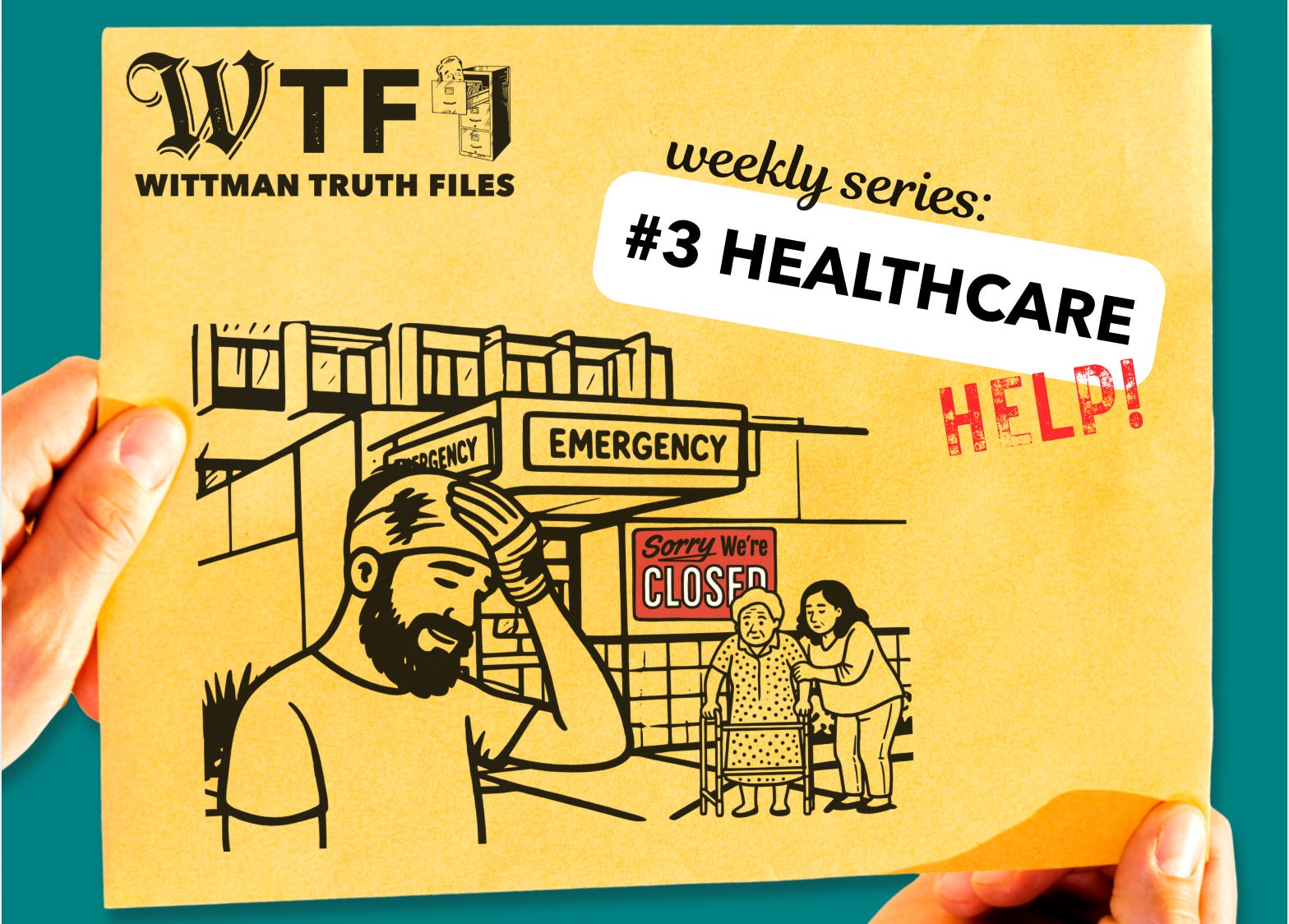
Wittman Truth Files #3: Healthcare
He put a hospital in his own district on the “at risk” list.
Welcome back to WTF: the Wittman Truth Files. We’ve opened the affordability file and the jobs-and-economy file. This week, we’re examining healthcare – and Wittman’s record ain’t lookin’ so great.
Health underpins everything. Tax cuts, gas prices, jobs, and the rest matter only after we care for our bodies and minds. In the First District, we rely on the VCU Health Tappahannock Hospital that delivers our babies and stabilizes stroke victims; the VA clinics in Fredericksburg and Yorktown that treat backs wrecked in the Navy; the ACA Marketplace plans that a single mom in Spotsylvania uses to cover her daughter’s asthma inhaler; and the Medicaid cards that Northern Neck nursing home residents hand over every month.
All of these are in trouble right now, and Rob Wittman’s votes are to blame.
The healthcare landscape, May 2026
We warned that Wittman’s votes would bring disastrous consequences to VA-01, and those consequences are now materializing:
More than 1 in 10 Americans who had ACA Marketplace coverage in 2025 now rank among the uninsured, according to a March 2026 KFF survey.
The average ACA Marketplace enrollee’s net premium rose an average of 58% in 2026, and subsidized enrollees who kept the same plan saw premiums more than double — a 114% increase on average — after the enhanced premium tax credits expired on January 1, 2026.
The average deductible jumped about $1,000 per person as families resorted to cheaper plans.
In Virginia, 33,000 fewer people enrolled in the Marketplace for 2026. The Commonwealth Institute estimates an additional 310,000 Virginians will be kicked off Medicaid because of the One Big Beautiful Bill.
The Congressional Budget Office projects nearly 10 million Americans will lose health insurance by 2034 because of that same law.
And as of June 2026, 13 Virginia hospitals — one third of all Virginia’s rural hospitals — are flagged as financially at risk of closure or service cuts because of those Medicaid reductions. Our own district’s VCU Health Tappahannock Hospital is at highest risk of closure.
That last sentence deserves to be read again. The congressman who represents Tappahannock voted for a bill that puts the hospital in Tappahannock on a national list of hospitals most likely to reduce services or close. WTF, Rob?
The pledge, the vote, the spin
In WTF #1, we included a story that bears retelling here in detail, because everything makes sense once you understand the pattern at play.
In March and May 2025, Wittman signed two letters to House and Senate leadership pledging he would not vote for any bill that cut Medicaid for vulnerable Virginians. About 100,000 of his constituents — 1 in 8 people in VA-01, or 12.5% — depend on Medicaid, according to Families USA. Statewide, 1.9 million Virginians rely on the program.
On July 3, 2025, Wittman voted yes on the “One Big Beautiful Bill” Act (properly known as H. R. 1, or what Wittman likes to call “The Working Families Tax Cut Act”; we’ll refer to it as H. R. 1). It enacted the largest cut to Medicaid in American history: $911 billion over a decade, per the non-partisan Congressional Budget Office (CBO). The Joint Economic Minority Committee projected over 20,000 VA-01 residents would lose insurance coverage as a result.
Two weeks later, Wittman sent constituents an email titled “Setting the Record Straight on H. R. 1.” In it, he claimed the bill makes “no cuts in Medicare and Medicaid,” that hospitals would actually benefit, and that “rural hospitals will get quite an influx of dollars.” He wrote:
“The only people who are losing access to Medicaid benefits are illegal immigrants, deceased individuals, and able-bodied adults who choose not to partake in community engagement requirements. This legislation roots out waste, fraud, and abuse by removing people from the program who are ineligible.”
—Rob Wittman, August 2025
This was and is clearly false, as the evidence provided by the KFF, Urban Institute, FactCheck.org, and RAND Corporation shows.
Look at where we are now, nine months later: 310,000 Virginians are projected to lose Medicaid. Virginia’s hospitals lose $2 billion a year. Ten Virginia hospitals are on a national at-risk list. VCU Health Tappahannock is on that list. Setting the record straight, indeed.
The Tappahannock test
Wittman’s defense is the claim that H. R. 1’s $50 billion Rural Health Transformation Program (RHTP) will save rural hospitals. He’s used this as a talking point; he issued a press release in December celebrating Virginia’s $189 million RHTP allocation, and he wrote in March that he has “supported the Rural Health Transformation Program to help stabilize and modernize rural hospitals.” Even in late May 2026, he sent an email saying, “I am pleased to have been able to secure this historic investment in Virginia’s rural health institutions.”
Here’s what he leaves out. KFF estimates that H. R. 1 will cut $137 billion in federal Medicaid spending from rural areas over ten years. The $50 billion RHTP fund covers, at most, 37% of that cut — but that won’t ever happen because of the restrictions the Trump administration put on the allowable use of that money. They capped the share of the fund that can be used for health provider payments at 15%. This means 85% of the RHTP funds can only be used for things like workforce training, infrastructure, and health information technology. None of that keeps a rural hospital’s doors open or compensates it for the Medicaid patients it’s treating at a loss. The cuts of H. R. 1 are real and are devastating healthcare across the country – especially in rural areas that rely on Medicaid more than other forms of health insurance.
Wittman also portrays himself as instrumental to Virginia’s securing the RHTP funds, but that’s also deliberately misleading. The funds are distributed based partly on a formula and partly on applications from state governments. Wittman and his fellow Virginia Republicans in Congress – Jen Kiggans (VA-02), John McGuire (VA-05), Ben Cline (VA-06), and Morgan Griffith (VA-09) – are using the fund to cover up their otherwise-empty legislative achievements.
It’s also worth noting that the fund lasts five years. The Medicaid cuts are permanent.
Centra Southside Community Hospital in Farmville is also on the at-risk list, and has already shut down its labor and delivery unit, OB-GYN surgical services, and its affiliated women’s center, citing “recently enacted reductions in federal healthcare funding.” That’s a preview of what closure of services looks like. Mothers driving an hour to deliver babies. Heart-attack patients losing the precious minutes that determine whether they survive.
Wittman calls this “stabilizing rural hospitals.” WTF, Rob?
The ACA subsidy whiplash
By autumn 2025, every member of Congress knew what would happen if the enhanced ACA premium tax credits expired on December 31. KFF had said it. Insurers had said it. AARP had said it. Virginia’s State Corporation Commission had the numbers: over 300,000 Virginians used those credits.
Wittman, having voted in July to let them expire, watched as constituents stormed his October tele-town hall. One wrote in the chat: “Republicans do not want to take responsibility for the horrendous increase in health care premiums.” Another: “You took away $150 billion from hospitals!!”
The federal government shut down for 43 days — the longest shutdown in U.S. history — largely because Senate Democrats refused to reopen it without an extension of those credits. Wittman publicly demanded a “clean” reopening with no extension. The credits expired anyway on January 1, 2026.
A week later, after the damage was done, after open enrollment had already locked in higher premiums for hundreds of thousands of Virginians, Wittman became one of 17 House Republicans to vote for a three-year extension. The Senate didn’t pass it. The credits were already cut off, and they remain expired today.
And he’s still spinning it! On June 1, Wittman emailed constituents headlined “Protecting Virginians from Sudden Health Care Cost Increases,” taking a victory lap for the January vote, while his July vote that caused the crisis goes unmentioned. It’d be a masterclass in political deception if it weren’t so transparently cynical:
To claim the high ground of authority on the subject, his email opens by reminding us he has a master’s in public health and 26 years at the Virginia Department of Health. But this only makes him look worse to the informed voter: Wittman, a supposed expert in public health, understood exactly what H. R. 1 would do and voted for it anyway.
He writes that the ACA credits “expired at the end of 2025,” as though they lapsed on their own, like milk left out too long. They didn’t. Congress let them lapse, and Wittman voted for the bill that made it happen – and he’s consistently voted to destroy the ACA.
He frames the extension as “guided by the input of thousands of constituents” — a tidy phrase for the constituents who flooded his offices and town halls after he’d already voted to raise their premiums.
And he reassures readers it was a “strictly temporary” fix, that he still opposes “permanent expansions of federal health care programs.” This is targeted at his political base and translates as: “The one healthcare vote that actually helped you was a reluctant exception, so please forgive it.”
Wittman’s “moderate” vote arrived seven months too late, after he’d already cast the “yes” that let the credits lapse, and only after his town hall comment sections turned into a public roast. Heroic.
The wrecking crew at HHS
While Wittman’s healthcare votes were doing their slow damage, his silence enabled faster damage at the Department of Health and Human Services. Since the administration installed Robert F. Kennedy Jr. as HHS Secretary, HHS has:
Fired or forced out four NIH institute directors, the FDA’s former vaccine chief, and an ousted CDC director
Cut nearly half of the CDC’s budget, with thousands of employees gone including specialists in violence prevention, smoking, reproductive health, and drowning prevention
Cancelled $500 million in mRNA vaccine contracts
Withdrawn $1.3 billion in unspent Mental Health and Substance Abuse Block Grant funds that states, including Virginia, were counting on through year-end
In the FY2027 budget request, proposed a 13% cut to NIH and a 32% cut to the CDC
Two unvaccinated school-age children died of measles last year — the first U.S. measles deaths in a decade. Veterans’ services, already gutted by the nearly 30,000 VA staff reductions we covered in WTF #2, have lost over 2,700 nurses and 1,000+ psychologists and social workers in our district’s VA service areas.
How many public statements have come from Wittman opposing any of this? Zero. As Vice Chair of the House Armed Services Committee, with a sizable veteran constituency in Yorktown, Fredericksburg, Quantico, and the Northern Neck, his silence is its own kind of vote.
The tax break with his name on it. Again.
We mentioned this in WTFs #1 and #2. It belongs in the healthcare Wittman Truth File, too. The same law that cut Medicaid by $911 billion and let the ACA subsidies expire saves Rob Wittman personally between $19,900 and $59,300 a year, per the Institute on Taxation and Economic Policy. The average Virginia working family’s benefit: $40 to $50.
A nurse at Tappahannock Hospital — assuming the hospital remains open at all — gets $40 for helping members of our community. Wittman gets his $59,300 for doing nothing.
What this means for you
If you have an ACA Marketplace plan, your premium may have more than doubled (as no doubt you’ve noticed). If you have Medicaid, you’ll re-verify your eligibility every six months starting in 2027, and you’ll probably do the paperwork your caseworker doesn’t have the bandwidth to process. If you’re a veteran, your VA clinic has fewer nurses and longer waits. If you live near Tappahannock or Emporia or Farmville or South Hill, your hospital is on a risk list.
Rob Wittman wrote us all an email saying none of this would happen. Then he voted to make all of it happen, issued a press release about a $189 million rural-hospital fund that won’t close even half of the gap — and continues to send emails taking credit for the performative vote that purported to undo a sliver of the damage. And he refuses to face you in person about any of it.
He has not held an in-person town hall since 2017, nine years ago. The next time he tells you he has “supported” rural hospitals or “protected” Medicaid, ask him about VCU Health Tappahannock. Then call his Glen Allen, Yorktown, or DC office, show up at his next staff-only mobile office hours, and remind him whose healthcare he’s destroying.
The fourth Wittman Truth File will be opened next week.
The Wittman Truth Files (WTF) is a weekly series profiling the gap between Rep. Rob Wittman’s public claims and his voting record. If you found this useful, share it with a neighbor and your social channels, and subscribe to get next week’s installment right in your inbox.
Great Wittman Watch Analysis of what Congressman Wittman’s YEA vote on Trump’s Big Beautiful Bill will do to Virginians ( and all Americans ) Affordable Healthcare Act increased monthly payments and/or loss of that health care.
Rural hospitals now strain to stay solvent and operate from that lost revenue because of less subsidized federal healthcare recipients losing that ACA coverage.
When those rural hospitals close private equity (groups of billionaire investors) swoops in and buy that same hospital for pennies.
https://www.nih.gov/news-events/nih-research-matters/infections-falls-increased-private-equity-owned-hospitals
Do not forget that the Democratic legislated Hill Burton Act after WWII used taxpayer dollars to build the nonprofit hospitals in rural America that this private equity is now squandering.
https://en.wikipedia.org/wiki/Hill%E2%80%93Burton_Act