

We introduce: Shannon Taylor for Congress!
Wittman’s got a fight on his hands, and he’s not ready for it
Greetings from Wittman Watch HQ! 👋 🇺🇸
On Tuesday we urged you to vote (well done!) and talked about why we need to unite to beat Wittman.
Last Thursday we highlighted some of our recent rapid-response social media posts. If you’re on social media, find us there! (All of our social links can be found at the very bottom of this post.)
Here you’ll find the entire nine-part Wittman Truth Files series, which we recently wrapped up.
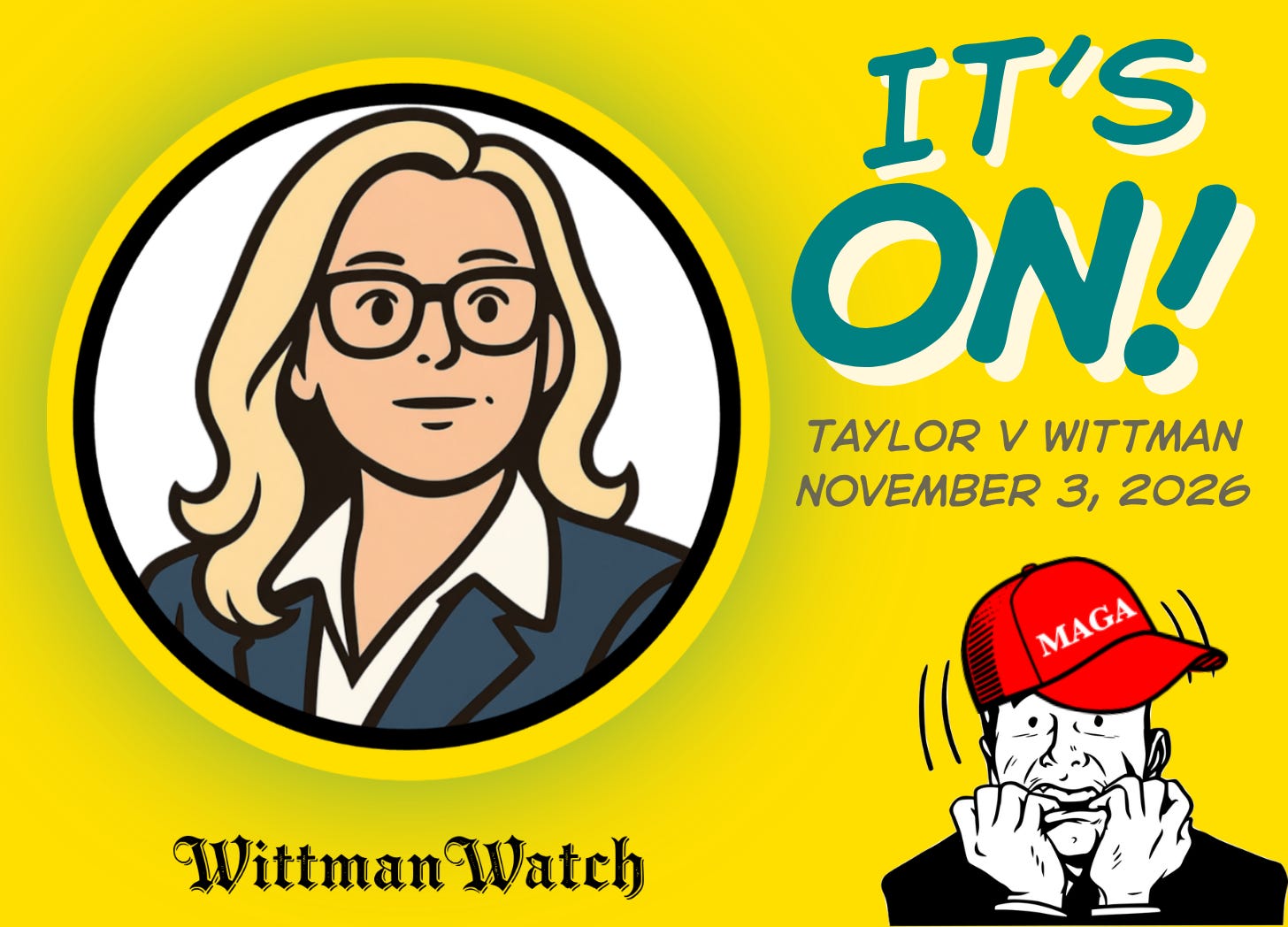
We now have our Democratic champion who will win the November 3 election and replace Rob Wittman as our representative for Virginia’s First District: Shannon Taylor!
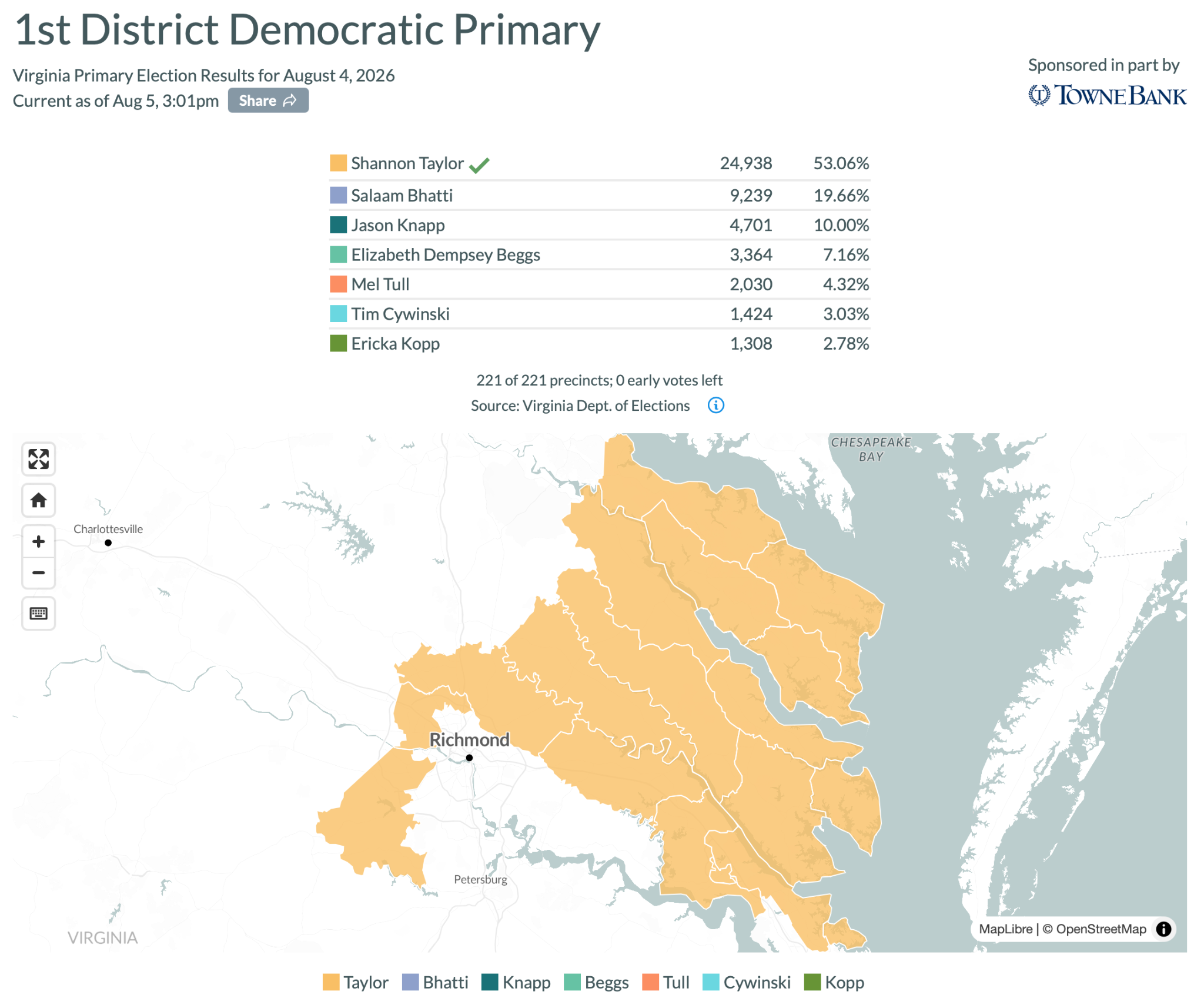
On Tuesday, she won a seven-way primary. And she didn’t just win – she won a majority of all the votes in nearly all counties across the entire district, even in that strong field of seven candidates. That’s remarkable, and we’ll dig into it more later.
Wittman is asking the people of VA-01 to elect him to a tenth term. He won re-election in 2024 by 13 points, and by comparable margins for a decade before that. He has never ever had to seriously compete for this seat.
That changes in 2026, and there are clear reasons why.
Taylor prosecutes the corruption that Wittman both enables and benefits from
Taylor is a lifelong Virginian and has been Henrico County’s Commonwealth’s Attorney since 2011, when she became the first woman ever elected to that office and the first Democrat to hold it in 24 years. The people of Henrico have re-elected her three more times, including in a 2019 race she took with 63% of the vote. She currently serves as President of the Virginia Association of Commonwealth’s Attorneys; her peers elected her to that position, demonstrating the respect she commands across the legal profession.
Titles are not achievements, but her record is outstanding:
Taylor has tried thousands of cases.
Her office reports a 90% homicide conviction rate.
She built a program to help victims of human trafficking.
She created a task force on the opioid epidemic.
She has prosecuted fraudsters who targeted working families.
She has taken illegal guns off the streets.
One case is particularly illustrative of Taylor’s success as a prosecutor. In 2020, Taylor charged Harry Rogers, a self-identified KKK leader who drove a pickup through Black Lives Matter marchers in Henrico. Taylor filed four counts of assault with hate crimes plus felony counts; Rogers was convicted and sentenced to six years, the maximum on each count. The judge rejected the hate crime enhancements because the victims were white, and Taylor publicly argued that the statute needed rewriting.
Taylor has a solid, 15-year career history of keeping our communities safe and successfully prosecuting criminals. Wittman’s career, by contrast, is a different story. He was a Shellfish Sanitation field director for the Virginia Department of Health before joining the Montross Town Council in 1986, then was elected mayor, followed by election to the Westmoreland Board of Supervisors, the Virginia House of Delegates, and eventually Congress through a 2007 special election.
Wittman has spent the majority of his career focused on being elected and re-elected. Taylor has spent hers being publicly accountable to her community.
Only one candidate fights for the people of VA-01
Voters report that their top three issues in this election are affordability, jobs and the economy, and healthcare. We examined Wittman and Taylor’s approaches for each and hoo-boy!
Affordability and the economy
Wittman’s answer to the skyrocketing cost of living hasn’t changed in a decade. He calls it a government spending problem and points to “waste, fraud, and abuse.” But that line has always been a lie, and his votes prove it. Wittman voted for H. R. 1 (the so-called “One Big Beautiful Bill”), a bill he initially opposed, which permanently cut taxes for the very wealthy and added $3.4 trillion to the national debt.

Taylor’s approach focuses on the fact that your costs are high in part because a handful of corporations face no competition. She supports breaking up illegal monopolies in tech, pharmaceuticals, and banking; cutting taxes for working families; and going after price gouging and predatory interest rates. She wants to grow jobs through energy, infrastructure, and small business investment.
That’s a real difference in diagnosis, not just in tone. Wittman thinks the problem is government (and remember, he has spent 19 years in Congress). Taylor thinks a meaningful part of the problem is concentrated corporate power. You can decide which approach will lower your grocery and electric bills.

Healthcare
H. R. 1 cut Medicaid and food assistance. In our district, that lands on rural hospitals like Rappahannock General, on seniors, and on families one diagnosis away from real trouble. Wittman voted for it. He apparently thinks closing rural hospitals constitutes fiscal responsibility.

Taylor’s position is to protect Medicare, Medicaid, and Social Security, lower prescription drug costs, and stop efforts to strip coverage or raise premiums – all things that Wittman has cut or has suggested will need to be cut to address “waste, fraud, and abuse.”
Who Washington works for
Should our representatives work for us, their donors, or themselves?
Taylor’s “Serve the People First” agenda is specific, which makes it checkable.
She will not buy or sell a single stock while in office.
She proposes a lifetime lobbying ban on former members, and mandatory jail time of at least a year for any member who steals $10,000 or more in taxpayer funds.
She backs a constitutional amendment to overturn Citizens United.
She pledges 12-year term limits and says she will honor them whether or not the bill passes.
She takes no corporate PAC money.
Wittman’s answer arrived on July 22, when he voted for the Stop Insider Trading Act and called it a restoration of public trust. That bill lets members keep the stock they already own and keep selling it, and exempts the executive branch entirely. Under the cover of this somewhat-reasonable bill, Republican leadership also bolted on a restrictive voter ID requirement, which is why very few Democrats voted yes.
For context on why this matters to him: during his time in Congress, Wittman has logged 206 trades across 110 companies, roughly $1.7 million in volume. And roughly 35% of his 2024 funding came from PACs, while only 2% came from donors giving under $200.
It’s clear who Wittman works for, and it isn’t the people of the First District.

People are voting with their wallets already
It appears that enthusiasm for Wittman and Taylor is reflected in their fundraising. Between April and June, Taylor’s campaign raised $754,466. Wittman’s raised only $617,555.
Yes, you read that right: even before winning the Democratic nomination, Taylor – a first-time congressional candidate – out-raised a 19-year incumbent who sits as vice chairman of the House Armed Services Committee. Incumbents in safe seats do not get out-raised. Donors do not move money into a race they believe is finished.
Wittman has had a 19-year head start, and has $4,269,830 in the bank compared to Taylor’s $1,181,300. That is a 3.6 to 1 advantage right now. But the trend line is the story, and the district’s own history says that Wittman should be very worried. Glenn Youngkin carried VA-01 with 58.6% in 2021. Abigail Spanberger carried it with 51% in 2025, a swing of nearly ten points in four years. When a Republican firm polled the district this April, Wittman registered 35 percent favorable, while 20 percent of voters had no opinion of him, and another 23 percent said they did not know who he was. After 19 years on the job.
Enthusiasm for Taylor is strong and sweeping
During the primary election race, commentators speculated on whether a moderate Democrat like Shannon Taylor would appeal to voters eager to institute radical change, or those in rural areas whose core concerns are perhaps not the same as those in Henrico (where Taylor works and lives).
The election results thoroughly dismiss those doubts!
As VPAP’s electoral map shows, Taylor won every county in the district, and in all but two counties she won a majority of the votes – and even in those two counties, she was at 47% and 49.7%! That’s significant. She competed against six other candidates who represented the broad spectrum of left-leaning politics, from the moderate to the super-progressive. Such a broad field would suggest the vote would be split among them, and the winner would get a plurality of votes. Instead, Taylor got a clear majority, especially in the more rural counties:
King & Queen: 67%
Westmoreland: 65%
Middlesex: 63%
King William: 59%
Northumberland: 58%
Lancaster: 58%
Essex: 58%
Richmond County: 52%
The Dems in this district believe that Shannon Taylor can beat Rob Wittman. And the polls suggest that the majority of Independent voters feel the same.
How the votes for other candidates might inform Taylor
Every candidate in this race, including Taylor, already shared some common priorities:
lower prescription drug prices
protection for Medicaid
higher effective tax rates on billionaires
reproductive rights in federal law
saving rural hospitals, and
getting big money out of politics.
The election results also show that 47% of the district favors policies represented by the other candidates. While it’s impossible to know exactly what drove those votes, we can hypothesize by examining the things these candidates highlighted most prominently.
Agriculture, fishing, and the rural working economy
Breaking up agribusiness monopolies and a bipartisan Farm Bill; policies supporting farms, fishing, and working waterfronts; tariff relief for watermen especially; and supporting mental health services in rural areas.
Healthcare beyond the ACA
Medicare for All / comprehensive universal healthcare / Medicaid for All. Taylor’s agenda focuses on maintaining or repairing what exists, whereas many candidates were pushing for fundamental changes.
Labor law reform
Expanding worker protections, including the right to organize in the workplace.
Immigration enforcement rebuilt around due process
Replacing ICE with a due-process system and hiring more immigration judges.
Data centers, utility bills, and who pays for the buildout
Many candidates made this a centerpiece of their campaigns, putting communities ahead of corporate profit.
Congressional war powers and a check on unilateral military action
Candidates were in favor of repealing open-ended war authorizations, and requiring congressional approval before action.
Childcare, paid leave, and family stability
Framed as a driver of economic growth, universal childcare and childcare plus paid parental leave featured in several campaigns.
A higher federal minimum wage
Consistently featured across several campaigns.
Taylor might incorporate some of these ideas into her campaign, though the balance is difficult. Several of these ideas are more “left-leaning,” but others – such as the focus on rural areas’ needs – suggest more right-leaning policies. Our hope is that Taylor will acknowledge that the district’s heterogeneity demands a broad range of solutions to fundamental problems on affordability, jobs, the economy, healthcare, Social Security, immigration, crime, foreign policy, election integrity, and education – you know, the things we know voters care about and that we already know Wittman has failed to address.
If you voted for Rob Wittman before…
…or if you’ve historically voted for Republicans, you may be torn about how to vote in November. But you see what’s happening in America. You know you didn’t send Rob Wittman to Washington to vote for a bill that cuts Medicaid in a district with so many rural hospitals. You didn’t send him there so your electric bill could explode while data centers get built. You didn’t elect him so he could hide in his office and refuse to appear at public town halls. Wittman has literally stopped showing up for you, in the district and in Congress.
Shannon Taylor spent 15 years prosecuting people who broke the public trust, without asking their politics (or their victims’ politics) first. If that record appeals to you, the party label next to her name shouldn’t matter. One of our favorite quotes is this:
Voting isn’t a valentine. It’s a chess move.
— Rebecca Solnit
And this is absolutely correct. It’s time to replace Trump’s pawn Wittman, and hold the would-be king Trump in check. Taylor is our knight, and is ready for the fight!
What to do next
VA-01 is now among the most watched races in the country. If this seat flips, the House likely flips with it.
Wittman has money and seniority. Taylor has momentum, a record, and a district that is shifting away from self-serving MAGA politicians. So what we need to do is pretty clear:
Compare it to Rob’s record.
Volunteer (with Taylor’s campaign or the No On Wittman campaign) to get out the vote, write postcards, and more.
See our Take Action page for even more ideas.
And vote on November 3, because we can’t afford Rob Wittman.
How will YOU support the Taylor campaign for Congress? What do you see as the biggest difference between Taylor and Wittman? Tell us in the comments!
To get the full picture on Rob Wittman, subscribe to this Substack (two emails a week, and we’ll never bombard your inbox about anything else) and any of our social media channels: Facebook, Instagram, BlueSky, or Reddit.