

Patriots of the USA
America’s heroes attempt to make our nation more perfect, and never shrink from the challenges of today or tomorrow
Greetings from Wittman Watch HQ! 👋 🇺🇸
On Tuesday we opened Wittman Truth File #7: Foreign Policy.
Last Thursday we discussed how and why to vote in the VA-01 Democratic primary.
Speaking of the primary: Early in-person voting is open, and will continue through August 1. (Election Day is August 4.) You’ll find all the info you need to cast your ballot here (and our candidate guide here).
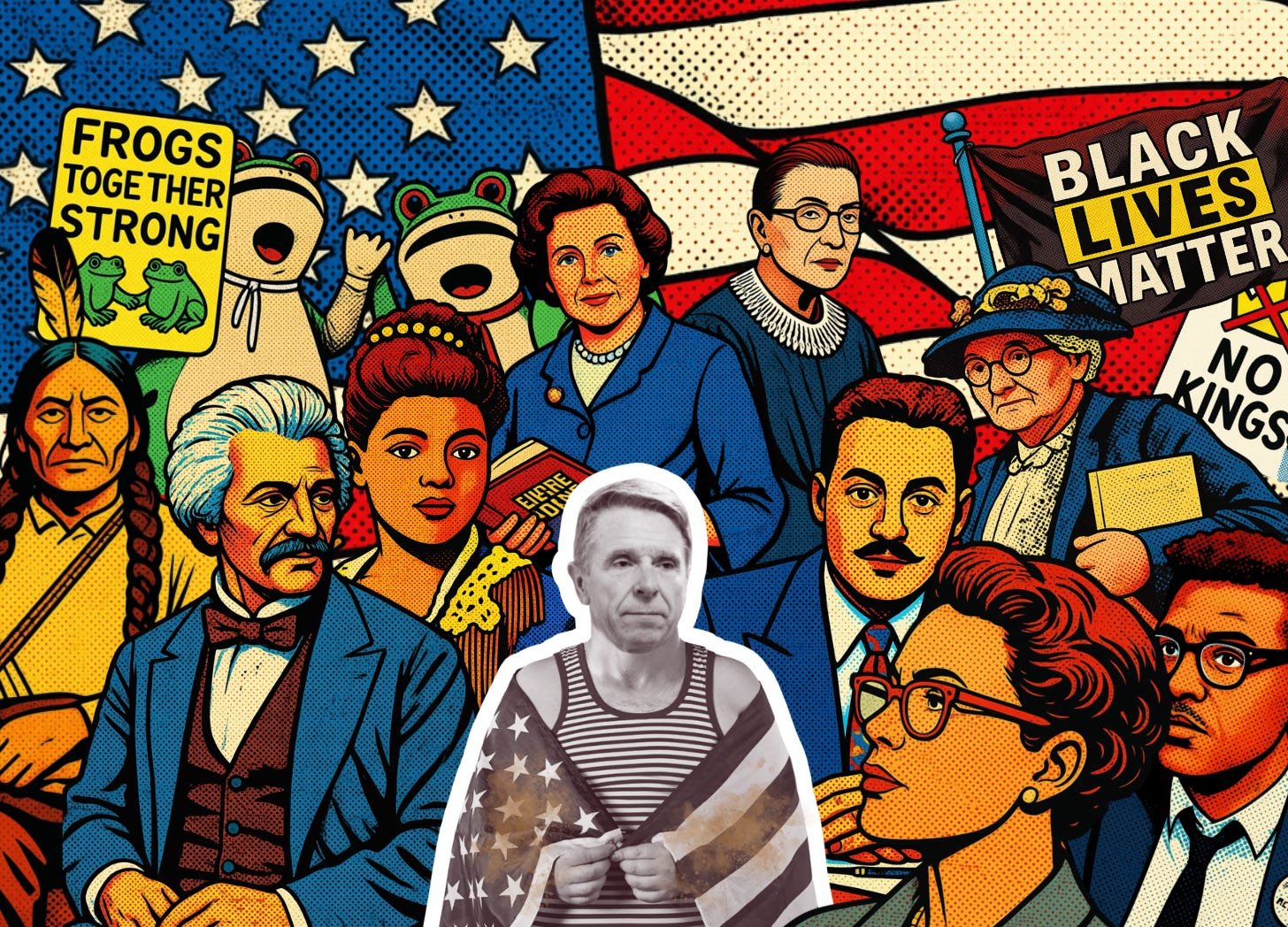
George Washington warned us about people like Rob Wittman, who love to wrap themselves in the flag while working to take away our Constitutional rights and liberties. As we’ve described, Wittman is a blind patriot: intolerant of criticism, staunchly obedient to his leadership, preoccupied with foreign threats, and performative in demonstrations of patriotic fervor. President Trump has begun to weaponize these instincts in a new attack on his political foes: Trump’s opponents are now being painted as communists, Marxists, socialists, or similar. His supporters are following along.
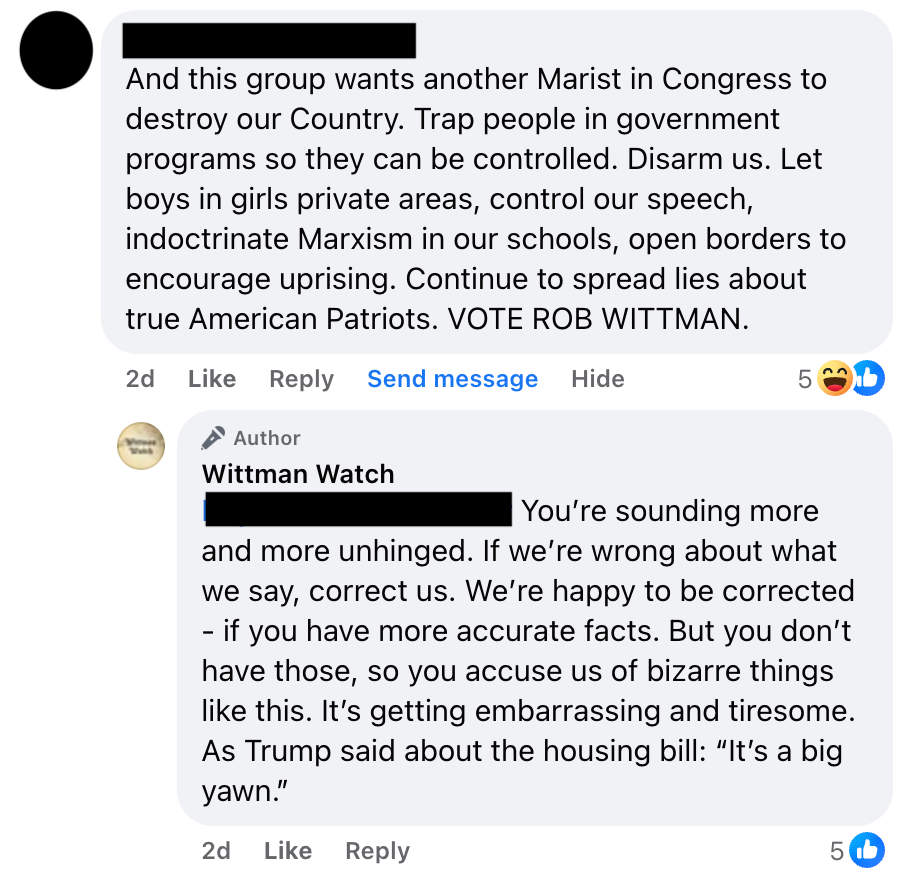
It is, of course, preposterous, as Karen McPherson eloquently describes:
When Trump says “America will never be a Communist country,” he is not speaking as an economist or political theoretician. He is speaking as a demagogue – much like A. Mitchell Palmer of the first Red Scare or Joseph McCarthy of the 1950s era blacklists. Neither of them was really worried about Communism – they were using the term as a scare tactic to accrue personal political power. That’s all Trump is doing.
It’s an indication that Trump is resorting to desperation measures to influence his supporters. At its heart is the idea that love of country demands fealty to the President and eager acceptance of whatever he and the nation’s government does in our name, no matter how morally or strategically wrong they may be.
With this attack, Trump has a problem: a look at history shows that love of America relies on the opposite of his ideas.
Fealty is not patriotism
The signers of the Declaration of Independence didn’t agree with their king and pledge fealty to his rule; instead they listed his tyrannical acts and devoted their lives, their honor, and their fortunes to creating a free, independent republic. If they were alive today, would they meekly accept the country as it exists, or would they continually demand better of it? We now consider them the original American patriots, but in their own time their king and many of their peers considered them rebels and traitors.
In writing the Constitution, the Founders of America understood that improvement of our nation would be a continual process. They wrote: “… in Order to form a more perfect Union… [we] ordain and establish this Constitution for the United States of America.” A more perfect Union. They knew this work would never be complete. We must always strive for greater heights, and that striving is central to the idea of America and being an American. It requires that patriots demand that America lives up to its founding ideals in ways that weren’t always discernible or apparent, and that we adjust our country’s government and Constitution as we experience, succeed, fail, and learn. This was what the Founders expected:
This paltry record [of only 27 Constitutional amendments] would have surprised the nation’s founders, who knew the Constitution they had created was imperfect and who assumed that future generations would fix their mistakes and regularly adapt the document to changing times. “If there are errors, it should be remembered, that the seeds of reformation are sown in the work itself,” James Wilson said to a crowd in 1787. Years later, Gouverneur Morris wrote to a friend about the mind-set of the Constitution’s framers: “Surrounded by difficulties, we did the best we could; leaving it with those who should come after us to take counsel from experience, and exercise prudently the power of amendment, which we had provided.” Thomas Jefferson went further, proposing that the nation adopt an entirely new charter every two decades. A constitution “naturally expires at the end of 19 years,” he wrote to James Madison in 1789. “If it be enforced longer, it is an act of force, and not of right.”
Our Constitution would be quite different if Jefferson’s expectations had been met! Instead, we have used the Constitution as a guiding framework while building legislation and governance that help us in our pursuits of happiness. Over and over in our history, across the entire scope of our country’s development, patriots’ love of America has been a catalyst for formation of that “more perfect Union.”
This is vitally different to the deceit that Trump established through MAGA: that going backwards would restore America to a former greatness. How is that progress? How does that resemble what the Founders envisioned of us, for us? It patently does not. The Founders understood that time’s arrow flies in one direction – onwards, and only forwards – and that the nation would improve with time if we were brave enough to embrace the challenges of it.
And, as we face down the growing threats of people like Rob Wittman in November, here’s the most important thing to remember: nearly all of America’s most lauded patriots were accused of being unpatriotic, un-American, or a threat to the nation — while what they were actually doing was holding America to its stated ideals. Trump, Wittman, and MAGA do not want America to reach for its ideals, but instead to return us, permanently, to an imperfect and selectively glorified past. America’s greatest patriots did not settle for the imperfect past in which they lived, and nor will we. We take inspiration from their examples.
Abolition and Racial Justice
Frederick Douglass was called a dangerous agitator and a threat to social order before he was lauded as a civil rights pioneer and intellectual giant.
Ida B. Wells was called incendiary and run out of Memphis for her anti-lynching journalism.
Thurgood Marshall was considered a radical troublemaker by Southern states before he became a Supreme Court Justice.
Medgar Evers was murdered in his driveway; he later had a federal building named after him.
Labor and Economic Justice
A. Philip Randolph was regarded as a radical for organizing Black railway workers; he is now recognized as one of the architects of the civil rights movement.
Eugene V. Debs was imprisoned for opposing World War I and ran for president from his jail cell; he is now celebrated as a founding figure of the American labor movement.
Mother Jones was called “the most dangerous woman in America” by a U.S. senator; she organized child workers and miners.
Women’s Rights
Susan B. Anthony was arrested for voting illegally and convicted; her face is now on the dollar coin.
Alice Paul was force-fed in prison while on a hunger strike for suffrage; she later drafted the Equal Rights Amendment.
Pauli Murray was the Black queer legal theorist who in 1962 developed the argument that the Fourteenth Amendment’s equal protection clause applied to sex discrimination, which Ruth Bader Ginsburg used nine years later to dismantle gender discrimination in court. Murray was dismissed as too radical on race and gender simultaneously for most of her career but is now recognized as foundational to both the civil rights and women’s rights movements.
Free Thought, Civil Liberties, and Conscience
Muhammad Ali was stripped of his title and prosecuted for refusing Vietnam-era military service; the Supreme Court unanimously overturned his conviction, and he became one of the most beloved Americans of the twentieth century.
Henry David Thoreau went to jail rather than pay taxes to support the Mexican-American War and was considered an eccentric crank; his essay on civil disobedience later influenced Gandhi and Martin Luther King Jr.
Roger Baldwin founded the ACLU in 1920 and was considered a communist sympathizer; civil liberties organizations now consider him foundational.
Environment and Public Health
Rachel Carson was attacked by the chemical industry as a hysterical amateur after publishing Silent Spring in 1962; her work led directly to Nixon banning DDT and the creation of the EPA.
John Muir was considered a romantic oddball for arguing that wilderness had intrinsic value worth protecting; he is now considered the father of the national park system.
Journalism and Whistleblowing
Upton Sinclair was called a socialist propagandist for The Jungle; he helped produce the Food and Drug Administration.
Daniel Ellsberg was prosecuted under the Espionage Act for releasing the Pentagon Papers; charges were eventually dismissed, and his disclosures are now widely credited with helping end the Vietnam War.
LGBTQ Rights
Bayard Rustin was pushed to the margins of the civil rights movement — even by allies — because he was openly gay; he organized the 1963 March on Washington and was awarded the Presidential Medal of Freedom posthumously.
Harvey Milk, the first openly gay elected official in California, was assassinated; San Francisco now has an airport terminal named after him.
Indigenous Rights and Anti-Imperialism
Sitting Bull and Chief Joseph resisted U.S. government policies that are now officially acknowledged as atrocities.
Mark Twain opposed American imperialism in the Philippines at the turn of the twentieth century and was considered anti-patriotic; his critique is now standard historical consensus.
While many of these individuals are considered American heroes today, it’s vital to note that “hero” status is not an affirmation of total goodness. Most of America’s founders owned enslaved people. Mark Twain bankrupted his own publisher. John Muir made many racist statements. We must see all these individuals as the flawed people they were, just as we are in our own ways, now. However, we can firmly agree that their patriotism to America was best expressed when they risked their lives, honor, and treasure to help our nation change for the better.
Great Americans understand that America’s greatness is a shared, unending project
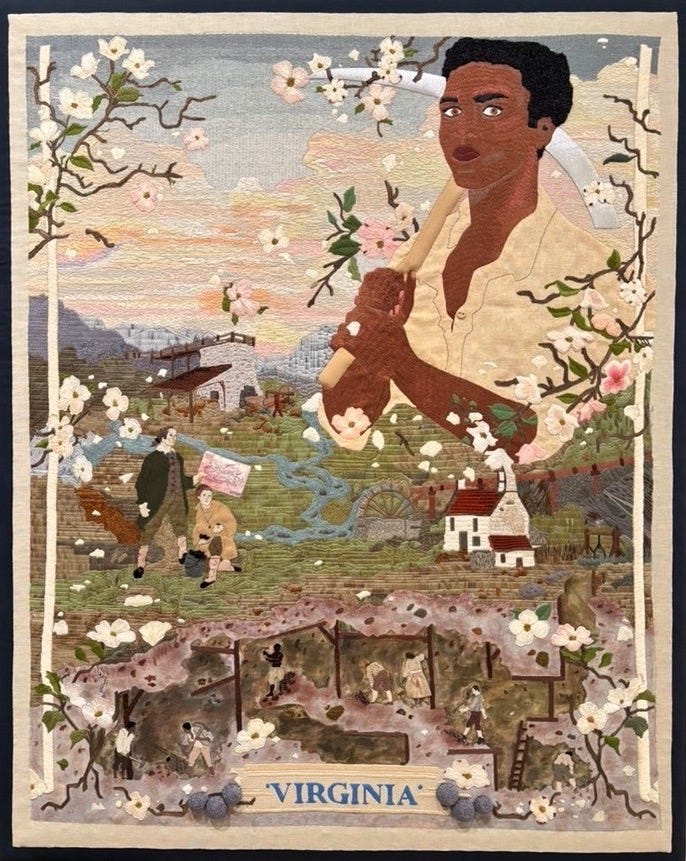
America’s patriotic heroes are a diverse group. They include Native Americans, Asians, wealthy individuals, impoverished people, Black men and women, Europeans, gay people, capitalists, Africans, socialists, environmentalists, justices, South Americans, writers, and an unlimited range of other categorizations. Many are captured in the America’s Tapestry exhibit, currently at the Muscarelle Museum of Art in Williamsburg. Embroiderers in the states that made up America’s 13 founding colonies have produced panels that enrich “our understanding of our shared heritage.” Virginia’s depicts the lead mines of Wythe County, where enslaved Black people worked alongside Welsh immigrant miners to produce the musket balls that (it is believed) were fired in the decisive Battle of Yorktown. One of these Black men, named Aberdeen, was granted freedom by the House of Delegates because of his long, patriotic service to America’s independence.
In Democracy in America, the 1835 study of the American political system, the French philosopher Alexis de Tocqueville wrote:
The greatness of America lies not in being more enlightened than any other nation, but rather in her ability to repair her faults.
America’s “greatness” has always been our ability to pioneer, embrace, and navigate change, and all the differences and challenges that changes present. Our nation has improved itself, and the fortunes of those who are born and choose to live here, by demanding more of each other, by questioning how to go further, and by committing to doing it for our greater good. That was the ethos of Washington and other great Virginians, who also had things to say about patriotism:
Patrick Henry: “Give me liberty, or give me death!” (1775 speech to the Second Virginia Convention), rallying colonists toward revolution.
Thomas Jefferson: Wrote that “the tree of liberty must be refreshed from time to time with the blood of patriots and tyrants,” and framed patriotism around the enduring right of citizens to reform their government.
James Madison: Argued that “the advancement and diffusion of knowledge is the only guardian of true liberty,” tying patriotism to an informed citizenry.
Woodrow Wilson: Declared that “loyalty means nothing unless it has at its heart the absolute principle of self-sacrifice,” and spoke of America as only meaningful as a collective — “something only if it consists of all of us.”
Arthur Ashe, the first Black man to win Wimbledon, the US Open, and the Australian Open, and who became equally renowned as a civil rights activist, author, and humanitarian, spoke pointedly about patriotic love requiring honesty. He described his complicated feelings as a Black American, noting that “true patriotism hates injustice in its own land more than anywhere else.”
Maggie Walker, the first first Black American woman to found and serve as president of a bank, in Richmond, VA, declared in 1914 that “The greatest power on earth for the righting of wrongs, is the power of agitation. When the spirit and power of agitation die among a people, they are doomed beyond all hope of resuscitation and redemption. So important is this power, that it is guaranteed to the people through the mandates of the Constitution of the United States.”
It’s our time now
And so we come to President Trump and willing acolytes like Rob Wittman. Consider the quotes above. How many can we say describe either man? If they are not living up to the ideals of America, and American democracy, what must we do?
The answer is obvious: we must eagerly confront the future – and never shrink from it, as the MAGA movement would prefer – with the same indomitable spirit of America’s past patriots. Each of us can (and must!) play a role in making sure that America lives up to its ideals, and the people we elect to Congress and the White House must do the same.
As we do this most patriotic and most American work, we might be called traitors, or communists, or some other name that’s been invented to label us as somehow un-American. When that happens, we should remember people like Daniel Ellsberg, Bayard Rustin, Rachel Carson, Muhammed Ali, and Susan B. Anthony – they were pilloried, condemned, and dismissed, only to be proven in time to be true American patriots.
We don’t expect or need a rebellion to reassert America’s ideals as pre-eminent, to make them more alive than they seem today, because they are already here: in you and all of us who are working to replace Rob Wittman and people like him in Congress, and in every government office in Washington, D.C. and around the country.
Trump, Wittman, and their supporters can call us whatever names they want. Their accusations are unfounded and are untrue, a product of their desperation to distract voters from the facts of how badly this administration is failing in practice and in principles. Our patriotism demands we risk our lives, our fortunes, and our sacred honor for Virginia and the country we love, this American experiment, our republic, our United States of America. One step at a time, our ideas will win because they are America’s ideals and, one way or another, our work will forge a more perfect union.
Who is your personal favorite American patriot? How do you express your patriotism in your own community? How do you think you can help your neighbors understand how Wittman uses patriotism as a shield to hide his terrible votes? Tell us in the comments!
To get the full picture on Rob Wittman, subscribe to this Substack (two emails a week, and we’ll never bombard your inbox about anything else) and any of our social media channels: Facebook, Instagram, BlueSky, or Reddit.
Am crying-this article speaks to our individual commitment to our community, our country and our neighbors. More importantly it speaks to our future and those we may or may not ever know who are depending on us to make the right decisions. We must not compromise our integrity. We must continue to move forward. We must do whatever we can, in small or great ways, to strengthen our country! Do whatever you can to-it will make a difference!!