

Through the perilous fight
This flag is your flag, this flag is my flag
Hi from Wittman Watch HQ! 🇺🇸
🌟 On Tuesday we published our shiny, brand-new, one-stop guide to the candidates running to unseat Rob Wittman. Check it out before you vote, and share it with everyone in VA-01!

🗳️ Early in-person voting for the VA-01 primary is open, and will continue through August 1. (Election Day is August 4.) You’ll find all the info you need to cast your ballot here.
Last Thursday we took a look at Wittman’s broken promises on the Chesapeake Bay.
Our WTF series will resume on Tuesday.
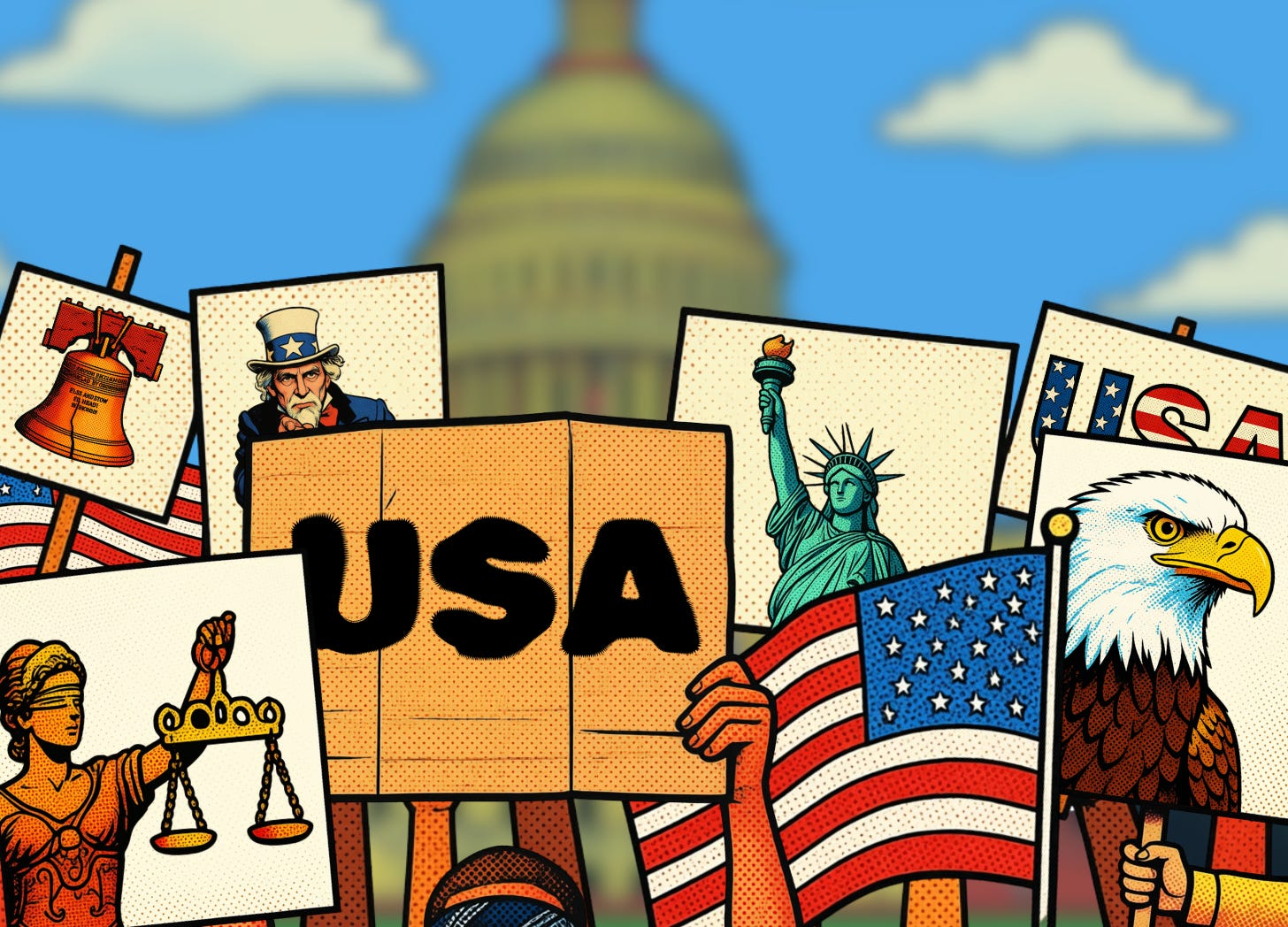
Our first President, the proud Virginian George Washington, left office in 1796. Since there was no precedent for the office of the American president, Washington had to conceive and embody the nature of the role. In his Farewell Address, he cautioned that political divisions should never overcome national unity:
“...the name of American...must always exalt the just pride of patriotism more than any appellation derived from local discriminations.”
Washington also warned that we must “guard against the impostures of pretended patriotism” — in other words, to be watchful of those who wrap themselves in the flag while actually serving other interests.
Washington’s words are particularly powerful because he voluntarily gave up power, handing it to John Adams upon his election by the people. Washington’s warnings came from alarming and dangerous patterns he could already observe in the early American political landscape:
Self-serving demagogues and faction leaders — who used passionate appeals to national loyalty to inflame public opinion and gather personal power, prioritizing their own ambitions over the country’s needs.
Foreign manipulation — agents of foreign powers (Britain, France) who would pose as patriots while steering American policy toward their own interests.
Party spirit masquerading as principle — politicians who claimed their factional agenda was in the national interest, when in fact they were dividing the country for political and personal gain.
Washington thought long and hard about how his actions would set precedent. He fulfilled the demands of his office based on his belief that genuine patriotism was quiet, steady, and self-sacrificial, and that the president should subordinate personal and party interests to the common good. In his Farewell Address, Washington warned that “pretended” love of country, cloaked in the language of patriotism, was the inversion of his beliefs: loud, self-serving, using the language of love of country as a tool of manipulation.
Washington didn’t distrust patriotism itself, only its counterfeits. Modern research has validated him.
Blind and constructive patriotism
In 1999 Robert Schatz, Ervin Staub, and Howard Lavine authored a study examining different concepts of patriotism. They noted that there’s a difference between “blind patriotism” and “constructive patriotism.” (The notion of blind vs. constructive patriotism isn’t immune to criticism, and is clearly not the only lens through which we can consider this idea. But it’s useful for describing what patriotism can mean in different groups and different contexts, as well as the implications attached to its symbolism.)
Blind patriotism
Characterized by:
Unquestioning positive evaluation
Staunch allegiance
Intolerance of criticism
Associated with:
Political disengagement
Nationalism
Perceptions of foreign threat
Placing outsized importance on demonstrations of patriotic behavior
Constructive patriotism
Characterized by:
Support for questioning
Criticism of current group practices that are intended to result in positive change
Associated with:
Political involvement
Political interest, knowledge, and behavior
In other words, people who question the country tend to be the most engaged citizens, while the loudest symbolic patriots tend to be the least engaged.
“Blind patriots” tend to revel in “glorification” – a feeling of ingroup superiority, respect for the group’s central symbols and rules, and antagonism toward those who do not show enough respect or otherwise criticize the country. The “flag-wrappers” tend to hand over decision-making to their leaders, without engaging in critical thinking. Glorification creates a receptive audience for demagogic patriotic appeals, and demagogues weaponize national symbols in service of their agenda.
Symbols as strategy
Nationalism requires deciding who truly belongs to a nation and who doesn’t. It encourages exclusionary, prejudiced attitudes and policies toward anyone within a country’s borders who is identified as “other,” creating hierarchies of citizenship that marginalize minorities, immigrants, and anyone who doesn’t fit the dominant cultural template at any given time. In America, this has historically meant that being “truly American” has been defined in ways that exclude Black Americans, Native Americans, Catholics, and Jews, among others, regardless of their legal status. Nationalism breaks relationships with other countries and destabilizes global politics by prioritizing power at the expense of stability, morality, and mutual benefit.
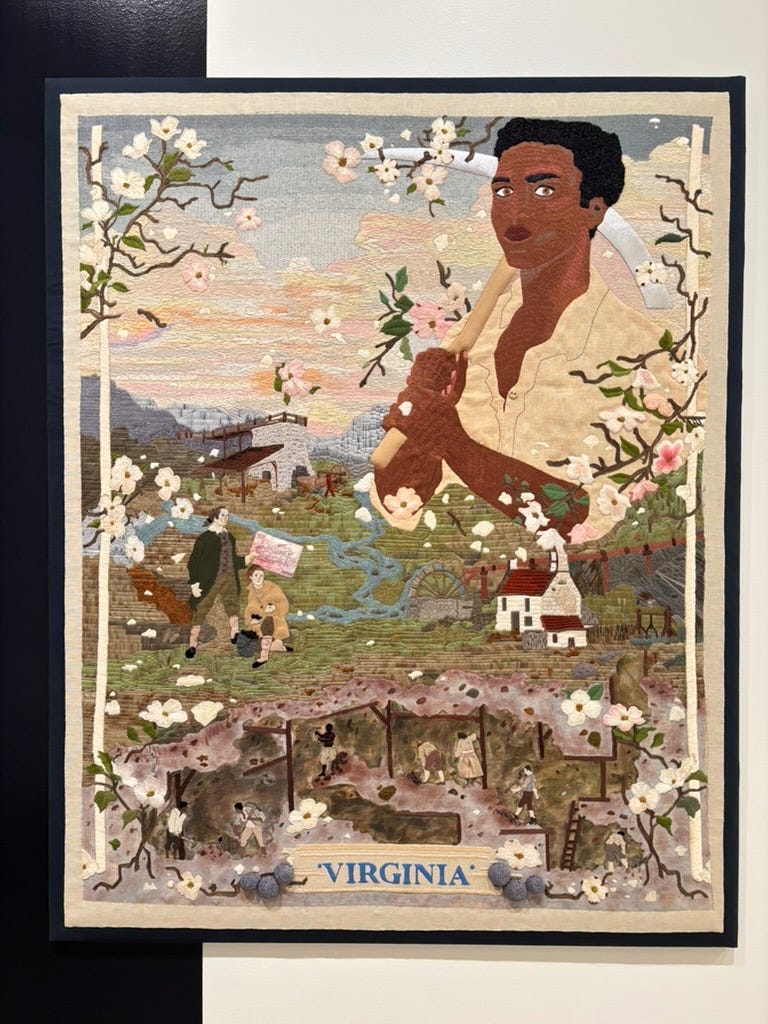
The Cato Institute (a libertarian think tank, not a left-wing source) says that nationalism operates at odds with America’s founding principles and institutions. Stoking the nationalist passions of the majority group in a democratic society creates a potent threat, since the majority can cause harm by abusing power. (Does this sound at all familiar?)
A wave of patriotic pride is not necessarily synonymous with nationalist fervor. For example, if U.S. athletes excel in the Olympic Games, a swell of national celebration, including flag-waving, is likely to follow . But in other circumstances, politicians deploy flags and symbols to activate in blind patriots a pre-loaded psychological package of nationalism.
This is a strategy, not an accident. A demagogue’s manipulation of national pride is central to their goals: define the nation narrowly so that only certain people count as “real” patriots, then paint opponents as enemies of the nation instead of legitimate political rivals. This is why Trump and his associates say Democrats are “evil” or “traitors” or must be “locked up.”
Ultimately, the people most likely to be manipulated by patriotic appeals are “blind patriots” — not engaged, critically-minded citizens who tend toward constructive patriotism.
Our nation has many symbols of national pride and identity: the Stars & Stripes, Lady Liberty, Uncle Sam, the bald eagle. The power of these symbols is that they evoke emotions that unify and resonate with us. We see them on battlefields, in high schools, at stadiums, on houses of worship, and atop our capitol buildings. We sing the national anthem with our hands over our hearts. Every American is entitled to have pride in these symbols, but many “constructive patriots” hesitate to display them precisely because they don’t want to be mistaken as “blind patriots” with all of the accompanying baggage. A recent survey illustrates the effect:
“A lot of Black Americans see the flag as a symbol of both inclusion and exclusion,” said Matthew Delmont, professor of American history at Dartmouth College. “Black Americans, more so than white Americans, also understand the flag can be used to justify a version of patriotism that is rooted in exclusion, with the flag being used to say ‘you don’t belong here.’”
And yet, for some Black Americans, like Mr. Jerry Esters in Detroit, the flag represents a heroic history where justice has prevailed. He speaks of Moriah Martin, his great-great-grandmother who was born into slavery:
“I’m kind of living out her dreams — what I did for a living, having a business, having a nice home,” he said. “I think that’s the American way, but we got to fight for it and we, as Blacks, fought for it.”
When we hesitate to embrace and safeguard our national symbols, the nationalist demagogues win; we allow them to use and abuse our shared symbols however they wish, including changing their meaning or rejecting it outright. Rep. Troy Nehls (R-TX22) demonstrated exactly this with comments about the Statue of Liberty:
We cannot allow this to go unchallenged.
It can be hard to embrace national symbols when we feel misaligned with the direction of the country, or when we have grave issues with its current leadership and agenda. But using these symbols doesn’t have to suggest agreement or satisfaction. Instead, our American iconography can remind us of the promise of what this country can and will be, and serve as a symbol of our own commitment to working toward those goals.
Wittman’s blind patriotism desecrates the symbols he professes to love
Rob Wittman loves to wrap himself in the flag. His national defense page frames military advocacy in sweeping terms: “We are at a critical juncture in our nation’s history; we must decide if the United States will retain its global primacy, or if we will concede our position to the malign intent of Communist China.” This kind of language is a classic flag-wrapping technique, making ordinary appropriations debates sound like existential battles for the American soul.
On January 6, 2021, Wittman showed his true colors. Wittman was one of the 147 Republican members of Congress who objected to certifying the 2020 presidential election. He voted against certifying Pennsylvania’s electors — despite no substantive evidence of voter fraud — after the U.S. Capitol was breached by Trump supporters, in a stunningly treasonous attack.
What’s more, Wittman co-sponsored a bill called the “Back the Blue Act” to ensure mandatory minimum sentences for assaulting an officer. Then, when Trump pardoned 1,500 January 6 defendants (600+ who assaulted police, and 170 who used weapons) over the condemnation of the Fraternal Order of Police and many Senate Republicans, Wittman was silent. Silent! Yet he routinely invokes constitutional democracy and the sacrifices made to protect it. The hypocrisy is off the charts.
Rob Wittman is a stark example of George Washington’s warning of “pretended patriotism”: he uses the language of American institutions while acting against them.
That Star Spangled Banner yet waves
Wittman Watch exists to hold Rob Wittman to account, to demand that he do better. It comes from our conviction that our district, state, and country can always be better. That’s probably why you are reading this right now. Like us, you tend toward constructive patriotism. And it’s time to reassert our shared rights to the symbols of our nation, and ensure they are not specifically associated with the flag-wrapping nationalism of the Trump administration and its enablers.
As Abraham Lincoln said at the battlefield and burial grounds of Gettysburg:
“It is for us the living, rather, to be dedicated here to the unfinished work … that this nation, under God, shall have a new birth of freedom – and that government of the people, by the people, for the people, shall not perish from the earth.”
We must not surrender the symbols of this nation we love to those who seek to appropriate them for their own purposes. Instead, we must passionately claim and embrace those symbols.
This is not a matter of being a Democratic or Republican voter, being on Team Red or Team Blue. America has been built by members of both parties, extinct parties, and no party. On America’s birthday — and every day — our symbols belong to all of us. They should serve to unite us, not divide us. Anyone who claims exclusive domain over them is a tyrant, and should be rejected by true, constructive American patriots.
The American project will never be finished. And, as long as we continue to commit to making ourselves and our country ever “more perfect,” neither are we.
Happy 4th of July, VA-01! And happy 250th birthday, America!
Fly the flag. 🇺🇸
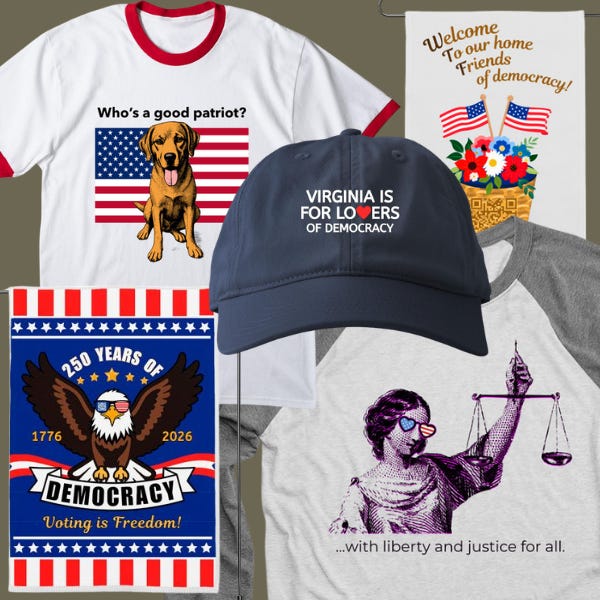
The Wittman Watch Store has a few items especially for patriots! The QR codes point to our website. (We make $0 on every sale.)
To get the full picture on Rob Wittman, subscribe to this Substack (two emails a week, and we’ll never bombard your inbox about anything else) and any of our social media channels: Facebook, Instagram, BlueSky, or Reddit.
Stunning article. Bravo. Every person in CD1 should read it.
Courageous article. We must be the courageous citizens who expect better from our government and each other. Happy 250 years of this Great Experiment and may we build better for the next 250!