

The real threats to election integrity
Wittman conspires to suppress the vote and retain power
Greetings from Wittman Watch HQ!
Last week we wrote about how Wittman is an environmental catastrophe.
On Tuesday we returned to our Myth of the Week series: Is Wittman a moderate? (Nope.)
Scroll down to see this week’s social media roundup.
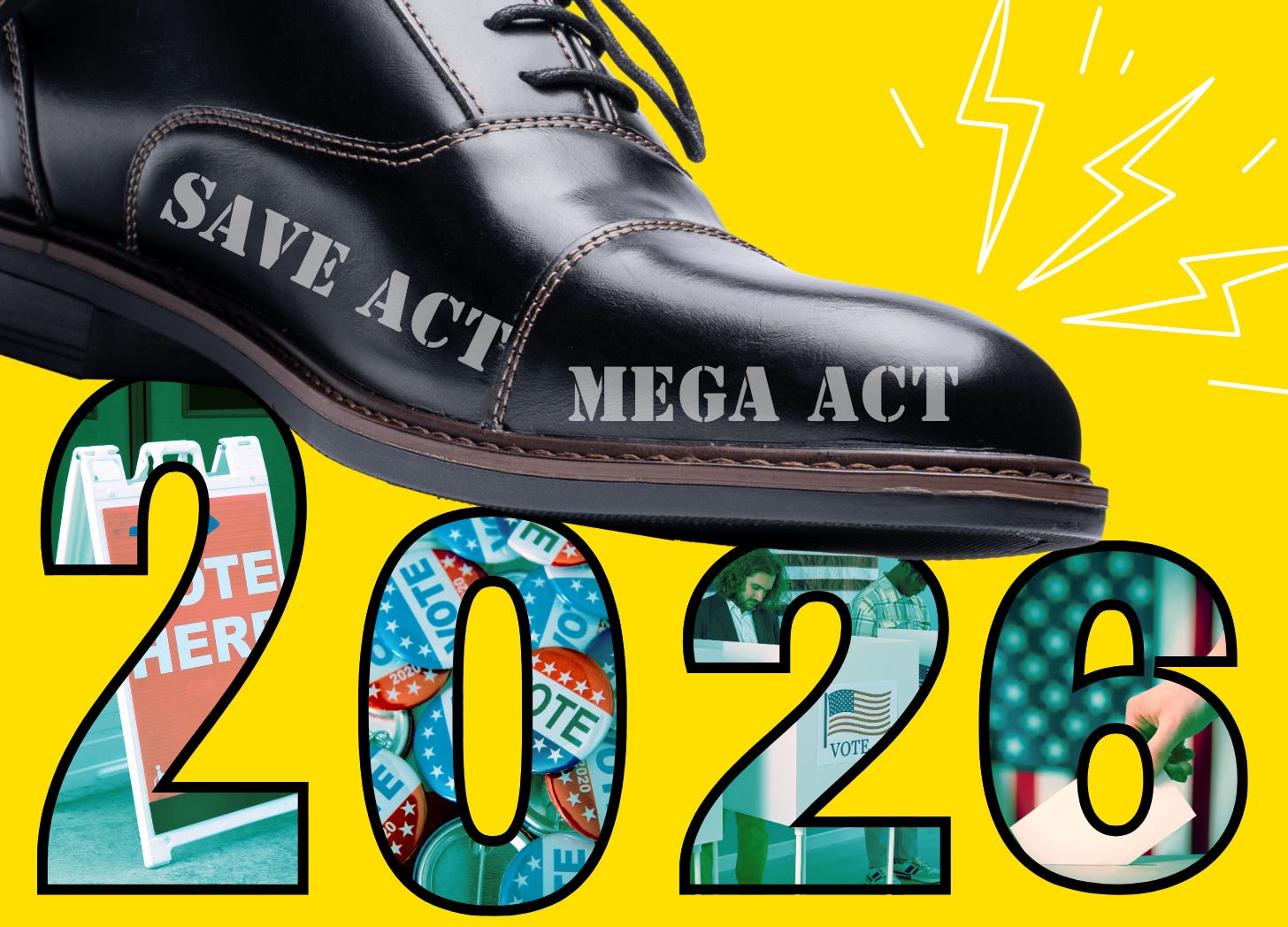
“Fraud, waste, and abuse” is a go-to phrase for Republicans, including Rob Wittman, when they’re trying to justify attacks on the foundations of our country. Accusations of fraud — even when they have no merit — serve to undercut trust in institutions, and open the door to “reforms” that the public would otherwise reject. Under President Trump (and with Rob Wittman’s support), Medicaid, SNAP, the ACA, USAID, the Education Department, and many other programs and agencies have been accused of rampant “fraud, waste, and abuse,” and consequently shredded — with no evidence to support the pretext that supposedly justified their destruction.
For those who aim to accumulate and hold onto power, our system of elections is an inconvenient complication. People who have worked to destroy the values, principles, policies, and institutions that voters hold dear cannot tolerate the possibility (or probability!) of those same voters ejecting them from office. In that context, rigging the voting system becomes an essential tactic to retain power.
Lest there be any doubt about the Trump administration’s goals for the upcoming elections, just read what Kristi Noem, Secretary of Homeland Security, said earlier this month:
“When it gets to Election Day, we’ve been proactive to make sure that we have the right people voting, electing the right leaders to lead this country.”
— Kristi Noem, Secretary of Homeland Security, February 13, 2026
Donald Trump has baselessly asserted that our voting systems are full of fraud. This isn’t new; the accusations began during his first term. The violent insurrection of January 6th, 2021 was the direct result of his disproven complaints that he lost because the election was somehow rigged. Since being re-elected in 2024 (via that same, supposedly fraud-ridden system), Trump has further amplified the accusations, and a complicit Republican majority in both houses of Congress has played along. The threat to our system of elections grows as Congress considers two new bills that will “reform” elections - with the same pattern of destruction in aid of the wealthy and powerful, at the grave expense of everyone else.
Voter fraud is a lie
If you’re at least 18 years old and a U.S. citizen, you’re eligible to vote. Each state has its own laws that govern its local, state, and federal elections. Most states require voters to register as residents in their states. Some states prevent individuals who are incarcerated, have been convicted of a felony, or have been determined to have a “mental incapacity” from voting. Otherwise, if you meet the requirements, you are an eligible voter. It is your right (and indeed your duty) to vote, because voting is the most vital and direct way in which we participate in and perpetuate our republic.
Trump and Rob Wittman have actively promoted the lie of “voter fraud” for years, with particular focus on alleged voting by non-citizens, and especially by immigrants who have entered the country illegally. In 2018 Wittman sent out a poll asking constituents if “citizenship should be required to vote,” even though U.S. citizenship is and has always been a requirement to vote in federal elections. He consistently supports “voter integrity” measures such as requiring documentary proof of citizenship, which U.S. states already handle effectively using existing processes. When Wittman voted for the Big Ugly Bill (H. R. 1), he stated that removing “deceased, ineligible, and non-citizen beneficiaries” from the voter rolls would “strengthen integrity.”
The facts are clear: accusations of rampant voter fraud are lies. The Brennan Center found only about 30 cases of voter inconsistencies — mainly resulting from confusion, not malice — out of 158 million votes cast in 2024. This is an error rate of 0.00001%. Even the conservative Heritage Foundation finds that voter fraud is an exceptionally rare phenomenon, affecting 0.001% of submitted ballots. Their voter fraud database found only 68 cases of undocumented immigrants voting since the 1980s. The existing system of shared responsibilities among federal, state, and local election officials assures multiple registration and voter roll checks to prevent illegal voting — which, by all measures, are working exactly as they should. An error rate of 0.00001% can be expressed another way: voting integrity measures are effective 99.99999% of the time — as close to perfect as can reasonably be managed. Illegal votes have never swayed elections one way or another. In other words: voter fraud is a lie.
Regardless, in March 2025, Trump signed an executive order to “nationalize” elections. He tried to walk it back, but the damage was done; Wittman and the Republican majority in the House validated his desires by proposing and passing legislation to disenfranchise voters, purge voter rolls, and make voting more difficult — all disguised as solutions to voter fraud problems that did not and do not exist.
Voter suppression in three Acts
Voter suppression attacks the two major steps of voting: how people register to vote, and how they cast their ballots. Three different bills are in play: the SAVE Act, the SAVE America Act, and the MEGA Act. The House and Senate have added amendments to each one to add more restrictions and fewer options for registration and voting. Here’s a summary of how the provisions of these bills compare and relate to one another.
Safeguard American Voter Eligibility (SAVE) Act
(S. 128, passed the House in April 2025)
The SAVE Act focuses on voter registration. It introduces significant challenges, burdens, and confusion for voters and election officials. It also destroys the Constitutionally-mandated line between federal and state responsibilities.
Requires in-person documentary proof of citizenship to register to vote
Birth certificate, U.S. passport, Consular Report of Birth Abroad, Certificate of Citizenship, or Naturalization Certificate
Online and mail registration become effectively impossible, since they still require in-person presentation of documents
Requires in-person documentary proof of citizenship for any changes to registration, such as a change of address
Frequent movers must repeatedly locate and present original documents
Married women who have taken their spouse’s name, and anyone who has had a legal name change, will face a major documentation mismatch problem when their birth certificate (or other citizenship document) does not match their married or changed name
The Brennan Center identifies the SAVE Act as the “worst voting law passed by Congress in recent memory.” A bipartisan group of 60 elected officials noted:
“The SAVE Act places an unfunded, unworkable, and legally risky burden on election administrators without offering the necessary resources of implementation support.”
In requiring changes to federal registration requirements, the Act would necessitate two separate sets of required paperwork: one for federal elections and another for state elections. That change would double the work for election officials, confuse voters, and lead to unwarranted delays and/or removal of eligible voters from the rolls.
The SAVE Act places new, unnecessarily stringent requirements on voters to provide official proof of citizenship in person.
Many voters, especially rural voters and seniors, do not have access to paper copies of their birth certificates, or the means to acquire them.
First-time voters would require official documentary proof of citizenship in addition to an approved ID in order to register to vote.
Rural voters and voters with disabilities might have to travel long distances to present their proof of citizenship in person, since online or mail-in registration is prohibited.
Voters who move even within the same state will be required to present documentation again when they update the address on their registrations. Approximately 9% of voters move within a state during the year, and may not update their driver’s licenses (which requires a fee) until they expire.
Passports can be used but, according to the State Department, 52% of voters do not have a passport. Since new passports cost $165 (and a renewal costs $130), this provision is in effect a return to Jim Crow-era poll taxes.
Any woman who has changed her name upon marriage will be unable to meet the requirement for her current legal name to match the name on her birth certificate. Pew Research suggests that 79-80% of married women in opposite-sex marriages take their spouses’ last names. This issue will affect approximately 69 million married women nationwide, and is a misogynistic encroachment on the voting rights of a huge segment of the population.
And remember: these new requirements, new costs for citizens, and new inconveniences do not solve any real problem. It makes no sense to make registration harder when only 65% of eligible Americans voted in the last election. If anything, this low level of participation is an argument for making registration easier and simpler for eligible voters.
While the SAVE Act passed the House in 2025, it didn’t pass the Senate, so it was effectively dead. But then along came…
SAVE America Act (a.k.a. “the new SAVE Act”)
(S. 3752, passed the House in February 2026)
The SAVE America Act originated in the Senate in February. It builds on the framework of the original SAVE Act and adds even more layers of registration requirements, as well as complications to the voting process itself.
Effectively eliminates online, mail‑in, and automatic registration
Adds civil and criminal penalties for election officials who err in collecting all required documents, even if the person is in fact a citizen and eligible to vote
Married women who face documentation mismatch would need a marriage certificate, divorce decree, or court order to connect their proof-of-citizenship document to their current legal name for registration
If unavailable, a married woman may present “an affidavit signed by the applicant attesting that the name on the documentation is a previous name of the applicant”; the Act says nothing about what form this “affidavit” might take, burdening the states with another unfunded mandate
Provides exceptions for absent military service members and their families
Additional nationwide requirement to show government-issued photo ID when voting
Passport, driver’s license or state ID, military ID, some tribal IDs
If no photo ID, may vote via provisional ballot
Voters who face the greatest registration and documentation challenges include Native Americans, naturalized citizens, low-income and rural voters, voters of color, and voters with disabilities
The SAVE America Act requires primary citizenship evidence to be presented upon registration: a birth certificate, a U.S. passport, a Consular Report of Birth Abroad, a Certificate of Citizenship, or a Naturalization Certificate. The big difference between the SAVE Act and the SAVE America Act is the additional requirement to present photo ID at the polls — but not just any photo ID. Acceptable photo IDs include a driver’s license that explicitly states U.S. citizenship (not a universal feature); a passport; a state ID; a military ID; or a tribal ID (but only if it contains a photo, an expiration date, and states U.S. citizenship, which most do not). A student ID — even one issued by a state university — is not valid for in-person voting in the state where the student attends school, nor is it valid for voting by mail in the state where the student permanently resides.
The final destructive blow is that the House version of this bill directs states to run their voter rolls through the Department of Homeland Security, forcing states to violate federal law that blocks sharing private information. Thus far, Virginia has refused to hand over unredacted voter rolls and is currently being sued by the Department of Justice.
The SAVE America Act takes what was awful about the SAVE Act and turns it up to 11.
Make Elections Great Again (MEGA) Act
(H. R. 7300; introduced in the House January 2026)
This focuses on the act of voting itself, while overlapping with the SAVE America Act’s registration requirements.
Requires proof of citizenship at the polls, at the time of voting
Government-issued photo ID required
Imposes national rules on mail ballots (received by close of polls on Election Day)
Bans ballot harvesting
Bans universal vote‑by‑mail
Bans ranked‑choice voting in federal elections
Mandates paper ballots
Expanded enforcement mechanisms, including civil and criminal penalties for election officials
Mandates centralized, official statewide voter registration databases as the controlling list for federal elections
Ends the 90-day quiet period before elections, which was designed to protect voters from being thrown off the rolls shortly before an election
The radical and un-American MEGA Act imposes unfunded and burdensome mandates on state and local election officials. With drastically reduced personnel and reduced funding, local officials would be required to purge voter rolls every 30 days — a huge administrative hurdle. Meanwhile, the Trump administration cut $60 million from the 2025-2026 budget designated for election security and administrative support at the federal and state levels. In the U.S., there are about 10,000 voting districts and one million election officials. There has been a massive exodus of election officials since the Trump turmoil of the 2020 election. According to media sources, 36-39% of voting districts have lost local chiefs or directors of elections, 50% of Western states have lost local chiefs, and 50% of all election sites have lost volunteer workers. The 30-day voter purge is consequently entirely unworkable, even if it were necessary — which it most assuredly is not!
Local election officials deciding whether to accept or reject a voter’s documentation would open themselves and their offices up to lawsuits and dire consequences for honest mistakes, effectively incentivizing the rejection of legitimate documentation. Officials could be prosecuted for failure to collect, verify, and retain appropriate documentation from voters. Voters could sue for undue delay in processing registration materials. The act would impose unfunded mandates in that state and local officials would need to provide additional personnel and financial resources to verify and complete the registration and voting procedures.
The MEGA bill prohibits universal mail-in voting; states would no longer be permitted to send ballots automatically to all active registered voters. This would immediately affect eight states and Washington DC, which routinely mail ballots to registered voters. Military voters and those living abroad might not have a practical way to present in-person documentary proof of citizenship, particularly if they need to register or re-register as a voter. Also, the MEGA bill tightens restrictions on who is allowed to return a filled-out ballot, which would prevent civic and community organizations from collecting and delivering voters’ completed ballots.
The MEGA Act requires that ballots be received (not mailed) by the close of polls on Election Day. The U.S. Post Office’s aggressive cutting of mail service, along with the new policy that mail will no longer be postmarked the same day it is received by USPS, threatens the disenfranchisement of rural and low-income voters as well as citizens with disabilities.
The MEGA Act would ban ranked choice voting (RCV) in federal elections. RCV is a method by which voters rank candidates in order of preference. RCV was used in New York City for their latest mayoral race, and Maine and Alaska have used it for federal elections since 2018 and 2022 respectively. RCV offers voters greater representation of their views because it doesn’t limit voters to a two-party system. And this is likely why Republicans want to ban it: greater variety of choices would dilute their chances of a majority, even after suppressing votes.
Passing these bills would SAVE nothing and be a MEGA disaster for election integrity
If any of the suite of SAVE/MEGA bills were to pass, they would become law for the 2026 election — just a few months from now. This haphazard, ill-conceived, and dangerous legislation would unleash chaos on election offices nationwide, and impose burdens that many would-be voters will be unable to resolve in such a short time. And this is, of course, the point.
In his endorsement of the SAVE Act and its rotten tendrils, Wittman demonstrates his craven willingness to prevent legal and eligible voters from casting a ballot. He has consistently supported voter fraud and “election integrity” legislation, endorsed unneeded expansion of citizenship checks, and overemphasized election security. In 2021, he voted to void Pennsylvania’s electors and reluctantly accepted Biden’s win. He has voted in favor of the SAVE Act and SAVE America Acts, and regularly touts these votes to his constituents. His actions are mirrored by scores of Republican members of Congress nationwide.
In special elections and state races across the country, Republicans are being booted out of office by angry constituents. Voter suppression is the last-ditch strategy of a desperate party and administration — so fearful of voters that their only hope is to prevent millions of citizens from exercising their Constitutional right to vote. Trump said ominously in 2024 that “You won’t have to vote anymore.” Now the complicit Wittman stands ready to make these words a reality. In supporting these Acts, Wittman will permanently install an autocrat in the White House and give himself a paycheck for life — at the cost of your vote, our democracy, and the American republic.
Let Wittman and all your representatives know you expect them to vote NO on the SAVE America Act and the MEGA Act. You can do it easily through this Resistbot petition.
As seen on our socials
Our social media channels respond quickest to whatever Wittman does or says. Here’s a selection from the past week. Click on each post to see them on BlueSky (no account necessary). Follow us on BlueSky, Facebook, Instagram, and Reddit to get immediate updates each time we post.
That’s a wrap
Please subscribe and share our (always free) content with your friends!
This November, we’ll make sure our seat is filled by someone who’ll work for us.