

Myth of the Week: Is Wittman good for small businesses?
When you look past the press releases, his votes tell the real story
Welcome to Myth of the Week, where we address some of the most-repeated myths about Rob Wittman’s work as our Congressional representative.
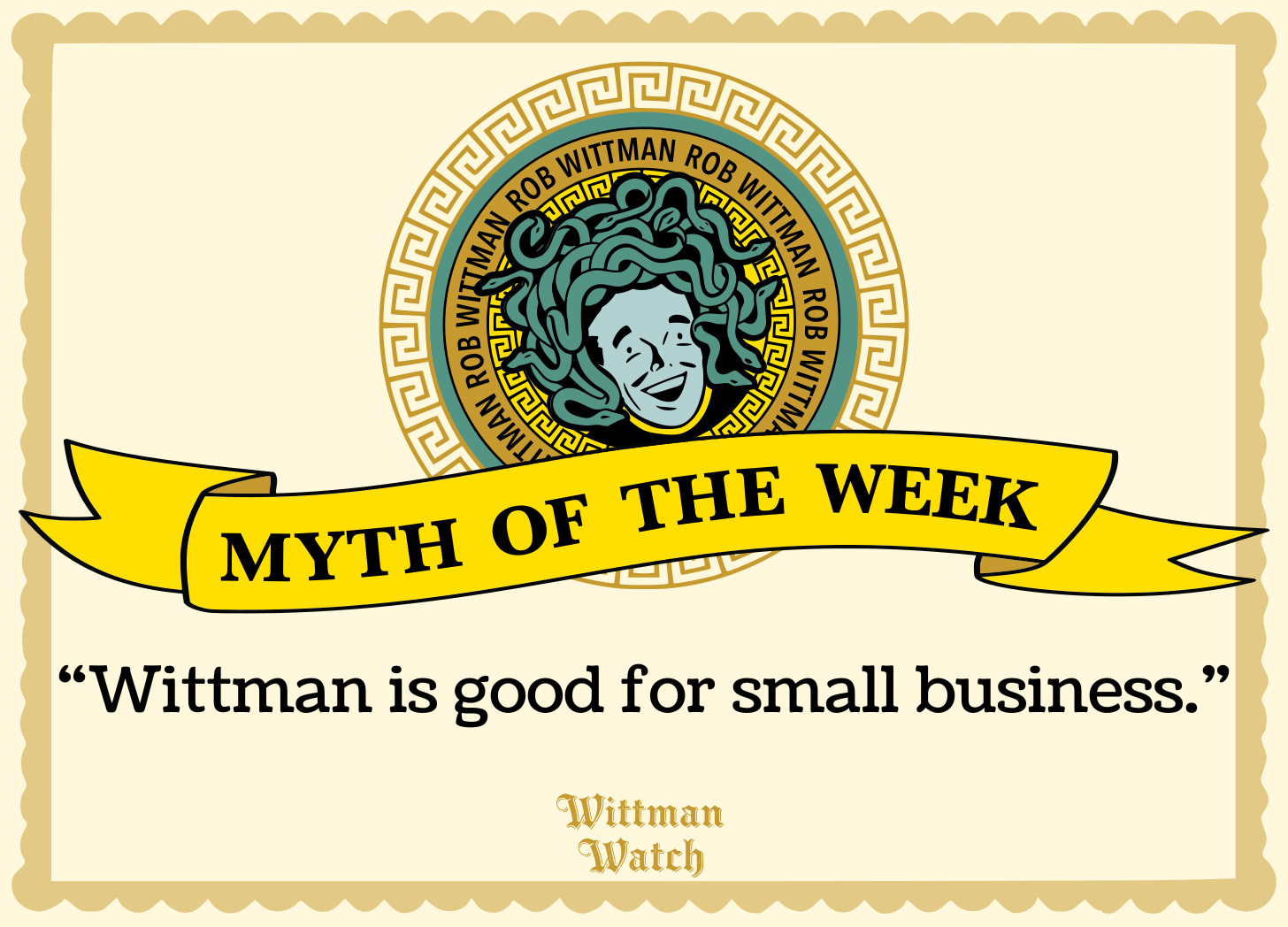
MYTH:
Wittman is good for small business.
REALITY:
Wittman talks like a small business champion, but votes to cut economic growth and make small businesses more vulnerable.
It’s National Small Business Week, and Rob Wittman and his allies want voters in his district to believe he is a practical, pro-small-business conservative. That story works if the audience only sees awards, roundtables, and tax-cut talking points. It falls apart when his full record comes into view.
For independent voters — and for Republicans and center-right voters who are uneasy with the current Trump-era direction of the country — the real question is whether Wittman’s choices have made it easier for ordinary people to run a business, keep workers insured, manage costs, and survive economic shocks. On that test, his record points in exactly the wrong direction.
Where Wittman deserves credit
Wittman has done some good for small business owners, and we’re happy to give him credit where it’s due. He supported extending the Section 199A pass-through deduction, a real tax benefit for LLCs, S-corporations, sole proprietors, and partnerships. His office says more than 59,000 VA-01 businesses file this way, and preserving that deduction prevented a significant tax increase for many of them.
Wittman is a co-sponsor of the Veterans Member Business Loan Act, which would make it easier for veteran-owned small businesses to access credit through credit unions — important in a district with a large military and veteran population. Notably, this bill hasn’t passed and might not ever pass. So while we acknowledge that it has Wittman’s support, we can’t count it as an achievement.
Why that’s not the whole story
The problem is that small-business policy is not just about tax treatment for pass-through income. It is also about whether owners and workers can afford health insurance; whether input costs are rising because of tariff policy; whether local contractors can count on the federal work that sustains Hampton Roads; and whether entrepreneurs can still access public infrastructure intended to help them start and grow.
Those broader tests matter much more than an award from a trade group or a lobbying group roundtable. Many voters of all stripes understand this instinctively. They do not want ideological branding. They want competence, stability, lower costs, and a government that does not add pressures to ordinary life. On those measures, Wittman’s record looks much less like practical conservatism and much more like reflexive loyalty to the Trump agenda — while ignoring the real needs of Virginians, whether or not they own small businesses.
Healthcare is where Wittman’s damage hurts most
Small businesses do not operate in the same universe as large corporations. They usually cannot self-insure, negotiate from scale, or absorb major benefit-cost shocks. Georgetown University’s Center for Children and Families found that 58% of small businesses have owners, employees, or family members who rely on Medicaid or CHIP, and 56% have stakeholders who depend on ACA Marketplace plans with premium tax credits.
That makes healthcare affordability a core small-business issue. Wittman failed to act for months on extending the enhanced ACA premium tax credits that kept coverage affordable for self-employed workers and small businesses. In Virginia, benchmark ACA premiums rose an average of 21.6% for 2026, with reporting and rate filings tying much of that increase to the expiration of those tax credits. Cardinal News reported that Virginians buying coverage on the marketplace were hit with massive increases, a burden that lands especially hard on self-employed people and small business owners.
This was not abstract. A Lancaster County small-business owner, Charlotte Hollings, said her premiums doubled after the credits were allowed to expire. Wittman eventually voted to extend the credits and was one of only 17 House Republicans to do so, which deserves notice. But that too-little-too-late vote — which came only after premiums had already spiked — could not erase the months of inaction that allowed the damage to happen in the first place.
Then came Medicaid. Wittman signed onto a letter urging House leadership to protect vulnerable people from harmful Medicaid cuts, only to turn around and vote for a bill that enacted those cuts. Wittman’s vote slashed Medicaid by approximately $863 billion over 10 years, and the CBO estimated that 10.3 million people would lose Medicaid or CHIP coverage. For Virginia alone, that’s an estimated 260,000 people projected to lose coverage — including over 20,000 in VA-01.
The Virginian-Pilot editorial board was blunt: Wittman and Rep. Kiggans “sold out their constituents.” The board called their reversal “a betrayal were it not so predictable.”
For an independent voter who values honesty and steadiness, this is the kind of record that raises a basic question: if a politician says one thing and votes the other way when party leadership calls, is there any value in their promises, pledges, and nice words?
Tariffs don’t help small businesses
Many voters (and especially independent voters) are skeptical of old ideological talking points from both parties, and rightly so. But the economics here are straightforward. When tariffs raise the cost of inputs and inventory, smaller firms with thinner margins get squeezed first.
Wittman has voted three times to protect Trump’s tariff regime from congressional oversight. That matters because those tariffs have real downstream effects. The Tax Foundation estimated that Trump’s tariffs cost the average household about $1,000 in 2025, rising to about $1,300 in 2026 if they remained in place. The Federal Reserve found substantial pass-through from tariffs into consumer prices in 2025, including an 8.5% year-over-year increase in prices for China-origin goods by December.
Small firms are less able than large corporations to hedge, stockpile, or negotiate supplier terms. A MetLife/U.S. Chamber of Commerce Small Business Index found that 75% of small businesses said rising prices had significantly affected them, and 46% called inflation their biggest challenge.
If a lawmaker campaigns on lowering costs and then votes to avoid scrutiny for cost-raising tariff policy, that is not pragmatic leadership. It is partisan compliance dressed up as economic toughness, and it’s protecting the tariffs themselves over American businesses.
DOGE cuts hit the local economy
Ours is not an ordinary district when it comes to federal spending and defense-linked employment. Hampton Roads depends on a broad network of contractors, subcontractors, service firms, and veteran-owned businesses tied directly or indirectly to federal activity. That means ideologically-branded cuts to government do not just land on nameless bureaucracies. They ripple outward through the private economy, into our towns, Main Streets, and neighborhoods.
Research from GovWin IQ found that more than half of DOGE-cancelled contracts were held by small businesses. Veteran-owned and service-disabled veteran-owned small firms were hit especially hard. Politico reported on veteran-owned businesses that furloughed staff or shut down after contract cancellations.
Virginia lost a net 23,500 civilian federal jobs in 2025, wiping out six years of federal job gains in less than a year. Old Dominion University economist Bob McNab estimates that this equals approximately 47,000 private sector job equivalents in economic impact. Small businesses serving federal workers in Hampton Roads and elsewhere in VA-01 felt that directly. CNBC removed Virginia from its list of top states for business, in part because of DOGE’s economic impact.
Wittman directly backed DOGE during a telephone town hall when his own constituents expressed concerns. When the rescissions package came to the floor to codify DOGE cuts, passing 214–212, Wittman provided a key vote in favor. Here’s what we said at the time:
Virginia has more than 234,000 federal workers, and polling showed DOGE was deeply underwater with Virginia voters - only 39% of people supported the DOGE cuts — including within VA-01. And Wittman voted for it anyway!
This is Wittman’s clear pattern: expressions of concern in his words, party loyalty in his voting record.
The SBA and business support infrastructure also matter
People trying to start or grow their businesses need access to practical support, and we want them to have it; when new businesses thrive, more jobs and opportunities exist for all of us. Small Business Development Centers, Women’s Business Centers, SCORE mentoring, and SBA-backed loan programs are key to building more and better small businesses. SBA also the National Small Business Week, which the administration is observing - or would be if President Trump could keep on topic for more than five seconds.
Wittman apparently wants to ensure that entrepreneurs don’t get help to start small businesses, grow, and compete. The White House’s FY2027 budget proposal - which Wittman has not opposed - calls for a 67% reduction in SBA funding, slashing the agency from roughly $1 billion to $329 million. This would eliminate $309 million from entrepreneurial development programs, including Small Business Development Centers (SBDCs), Women’s Business Centers, and SCORE mentoring services. The National Small Business Association (NSBA) flagged this budget as a serious threat to the infrastructure that helps small businesses start, grow, and compete.
A lawmaker who truly sees small business as the backbone of the economy should be standing up to defend this support structure, not siding with an agenda that weakens or removes it.
The NFIB award is real, but it is not a full performance review
Wittman’s supporters will continue to cite his NFIB “Guardian of Small Business” award, and indeed he did receive it. But to understand what it means, we voters need to know what it does and does not measure.
The award is based on how often a member votes with NFIB on a selected set of key votes, with a 70% threshold for recognition. Those votes reflect the priorities of one single influential trade group. They do not analyze or provide a complete picture of whether a member’s overall record lowers healthcare costs, moderates tariffs, protects local contractors, or preserves the public business-support infrastructure that many smaller firms rely on.
That distinction is important. An interest-group award is not proof that Wittman’s votes have improved outcomes for small business owners.
Voters should ask who benefits most
One of the most politically-revealing details in this debate is that the tax policy Wittman cites as proof of his small-business credentials appears to benefit him personally in a significant way. Analysis from the Institute on Taxation and Economic Policy found that Wittman could personally save roughly $19,900 to $60,000 annually from the extended pass-through deduction, largely because of income from his North Carolina rental property.
That does not make the deduction illegitimate, nor does it negate any positive outcomes for others. But it does undermine the moral simplicity of the sales pitch. If the centerpiece of a politician’s “small business” case also produces a major personal windfall while average families receive very modest benefits, independent voters are right to be skeptical.
What this says about the larger choice ahead
The argument for candidates other than Wittman is strongest when it’s grounded in practical outcomes. Progressive candidates tend to start from a simple premise: healthcare is economic policy, wages are economic policy, affordable child care is economic policy, infrastructure is economic policy, and stable democratic governance is economic policy. For small businesses and working families, that framework is often closer to real life than the narrower Wittman/Republican formula of tax cuts plus culture-war messaging.
A pro-worker, pro-healthcare, pro-stability agenda is also a pro-small-business agenda. Small businesses have the best chance of success when workers can see a doctor; when self-employed people can afford insurance; when tariffs are not randomly driving up input costs; when local contractors are not wiped out by ideological contract cancellations; and when startup support systems exist. Those are not fringe or abstract values, nor are they partisan ideas. They are the building blocks of a durable local economy.
If you’re an independent voter or someone who once voted for Wittman, ask yourself which candidate is more likely to protect healthcare access, reduce chaos, defend government accountability, and invest in the conditions that let ordinary people build a decent life. In today’s Republican Party, too many elected officials have shown that they will stomp on those goals for the sake of Trump-era party discipline — and Rob Wittman is a prime example of exactly that calculated betrayal.
The choice is not between perfect and imperfect, but between honest priorities
Wittman can fairly claim he supported one meaningful tax break for some business owners. But across the bigger questions that shape daily economic life — healthcare costs, tariffs, federal contracting stability, and business-support infrastructure — his record has been weaker, more partisan, and less honest than he’d like you to understand.
For voters who are tired of the chaos, tired of politicians saying one thing and voting another, and tired of being told to ignore the obvious in order to stay loyal to a particular party, that matters. The lesson of Wittman’s record is that he and his cronies too often protect the powerful, reward insider interests, and leave ordinary business owners and working families to absorb the fallout.
The better alternative is to support candidates whose policies line up with economic stability, healthcare security, accountability, and broad-based opportunity. If the goal is to vote for the people most likely to make daily life more affordable, more predictable, and more workable for ordinary Virginians, that case points away from Trump-aligned Republicans like Rob Wittman and toward candidates who are willing and able to govern from the ground up.
What do YOU think? Let us know in the comments here, or on any of our social media channels: BlueSky, Facebook, Instagram, and Reddit.