

Hi everyone! We’re back from a short break, and excited to pick up where we left off as election season ramps up.
Today we’re covering the topic on every Virginian’s mind: the redistricting referendum. On Thursday we’ll chart the rise and fall of a certain Congressional representative.
As always, make sure you click the Subscribe or Share buttons to give yourself and your friends the gift of Wittman Watch, and follow us on BlueSky, Facebook, or Instagram for in-the-moment updates on all things Rob Wittman.
Now, about that referendum…
What’s it all about?
There is a referendum in Virginia on April 21st. The question is whether we, the people of Virginia, will permit the legislature to redraw our Congressional district maps and use them in elections from November 2026 through 2030. The referendum is happening because other U.S. states have already done their own mid-decade redistricting, skewing their Congressional districts to favor the Republican Party. Consequently the referendum is important both for the future of Virginia and for America’s democracy.
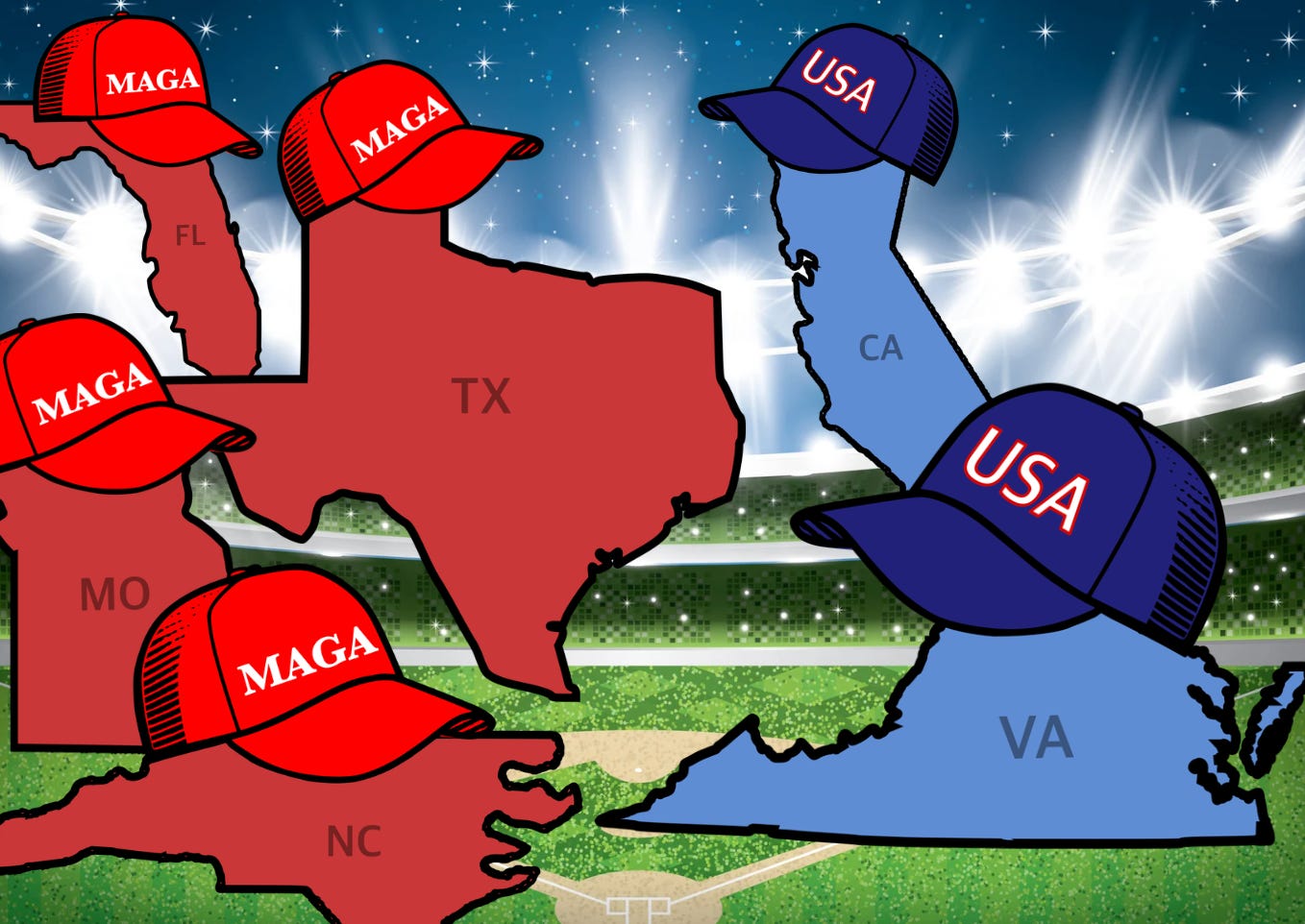
A YES vote will grant legislative authority to draw a new map now, outside of the usual once-per-decade redistricting. The legislature has published a proposed map, but the referendum itself is not a vote on the proposed map — only on permission for temporary redistricting to happen now.
Redistricting is a big deal, and VA-01 will likely change significantly under any new maps. Some of us would remain in the new VA-01 and others would be in VA-03, VA-04, VA-05, or VA-08. (Plug in your address on this page to find your likely new district.) In the run-up to the referendum, we’ve observed many misconceptions, deliberate disinformation, and outright lies — some of which has come directly from Rob Wittman.
What’s gerrymandering?
The USA is a representative democracy. In a government “by the people, for the people,” we elect individuals to represent our interests in Congress. The maps are intended to define contiguous, compact geographic areas in which people share broadly common concerns. Consequently, the maps are extremely important to the health of American democracy.
At least since the term “gerrymandering” was coined in 1812 when Elbridge Gerry manipulated Massachusetts districts, many politicians have tried to create districts that are favorable to them personally or that create partisan advantage.
How does gerrymandering actually work? Using census, voting, demographic, and other data, districts can be drawn so they’re “packed” full of people whose interests and voices are limited to a single district. Alternatively, groups can be “cracked” such that minority interest groups are broken up and spread out across districts to dilute their influence as much as possible. Gerrymandering means that some specifically-selected voters can be ignored. Our democracy becomes less representative and more skewed to the ambitions of specific politicians and political parties. In short, it’s a cancer that can kill what we hold most dear: American democracy itself could die.
With so much at stake, it’s time for some myth-busting!
Myth: “Republicans are against gerrymandering.”
Let’s be clear: both major parties engage in gerrymandering across the nation. It’s not a strategy consistent with the ideas of democracy and representation. And yet, 14 of the 20 most gerrymandered states benefit the Republican Party. Why is this number so high?
Project REDMAP was the beginning of the Republican Party’s concerted campaign to weaponize gerrymandering across the country. REDMAP had one clear goal: “flipping Democratic-majority state legislatures and Democrat-held state governorships for the express purpose of controlling redistricting.” And it worked.
“The effects of REDMAP first came about in the 2012 United States House of Representatives elections, in which Republicans were able to secure several districts and retain control of the United States House of Representatives by a 33-seat margin despite Democratic candidates collectively receiving over 1 million more votes than Republican candidates.”
Many argue that our current political situation is directly related to Project REDMAP. Without it, we may not have had Trump as president at all. The Republican Party evidently isn’t against gerrymandering as a practice; it deployed the most sophisticated attempt ever to use gerrymandering to lock in power at the state level. But Republicans are against it when it does not favor them!
For his part, Rob Wittman has been forthright in the past about gerrymandering. He says it’s bad… when it works against Republicans. (Wittman is always aligned with his party’s perspectives, no matter how morally bankrupt they are.) In 2016, he unsuccessfully argued that VA-03 was not drawn correctly because it disfavored the Republican Party. The Supreme Court told him to take a hike. But he’s said precisely nothing about gerrymandering where it favors Republicans, including the recent redistricting in Texas and North Carolina that pre-empted Virginia’s referendum. Are you shocked? No, neither are we.
Myth: “Obama and Spanberger say to vote NO.”
This myth is a product of a disinformation campaign that’s using images of Barack Obama and Governor Spanberger and out-of-context quotes to suggest they oppose the referendum. They have both explicitly released videos and messages urging a YES vote. Here’s Obama’s:
Here’s a report on Spanberger’s YES vote. The NAACP Virginia State Conference has held press conferences specifically to counter the disinformation campaign about Obama, and similar mailers targeting Black voters.
Sadly, disinformation campaigns are business-as-usual for Republican Party operatives nowadays. Rob Wittman continually publishes disinformation across his social media and repetitive emails, and billionaires such as Peter Thiel are actively funding lies/disinformation campaigns right now on the referendum.
It is true that Obama and Spanberger, and most Democratic politicians in Virginia, have campaigned against gerrymandering. The OneVirginia2021 campaign ran through 2021 and aimed to make gerrymandering impossible in Virginia. Obama and Spanberger (and several Wittman Watch volunteers!) supported that campaign. The independent redistricting commission was a product of OneVirginia2021’s efforts.
With the independent commission, Virginia’s Democrats and Republicans had declared a truce on gerrymandering. But then President Trump demanded that Republican-led states “find” more Republican seats in Congress. This clearly has changed everyone’s perspective on gerrymandering in Virginia. Obama, Spanberger, and others have seen that the truce has been violated, and the effects will blow back on all of us. They strongly urge all Virginians to vote YES.
Myth: “Redistricting is not something I need to care about.”
District maps are supposed to be drawn after every U.S. Census, which happens every 10 years. The Census shows who lives where in every state, and district maps should represent coherent communities based on that data. Mid-decade redistricting is extremely rare in U.S. history, but it has happened before: successfully in Texas in 2003, unsuccessfully in Colorado in 2003 (their state Supreme Court struck it down), and successfully in Georgia in 2005. In all three cases, the Republican Party initiated the mid-decade redistricting specifically to create partisan advantage in their states. And it worked: over 20 years later, the Republican Party maintains advantages in Texas and Georgia.
And now they’ve done it again, in Texas and North Carolina, with Florida and Missouri actively working on it too.
Myth: “Democrats started the redistricting war.”
Every state decides how to draw its own Congressional district maps. But NO state decided to redistrict at this time on its own. This latest mid-decade redistricting battle all started because President Trump demanded that Texas redistrict “to help keep [the] House majority.”
Asked…about the possibility of adding GOP-friendly districts around the country, Trump responded, “Texas will be the biggest one. And that’ll be five [Congressional seats].”
North Carolina has joined Texas in this effort, and they both did it without any referendum. Those state legislatures redrew their maps to skew more Congressional seats to the Republican Party without any consultation with their voters. Florida and Missouri are also working on their own redistricting efforts to skew their states toward Republican candidates.
Virginia’s Democratic legislators were watching this all unfold, even before the November 2025 elections. They noted that if any state pursued mid-decade redistricting to gerrymander their states, Virginia could counteract it. They went so far as to warn legislators across the country of Virginia’s ability to do so and, after winning majorities in the state, wrote it into a bill: “the General Assembly shall be authorized to modify one or more congressional districts … in the event that any State of the United States of America conducts a redistricting of such state’s congressional districts.” In other words: Virginia could redistrict its maps only if another U.S. state conducted a mid-decade redistricting of its own first. And of course that’s what has happened in Texas and North Carolina.
The bottom line is this: President Trump started this redistricting fight, and Virginia is not letting it go uncontested.
And Virginia isn’t alone in that response: California has preceded us, obtaining 64% approval for their new map. (Notice again how a Democratic Party led state went about redistricting only after getting permission from its voters to do so!)
Myth: “The independent bipartisan commission works fine.” / “The bipartisan commission will be permanently eliminated by a YES vote in the referendum.”
In 2020, to avoid partisan gerrymandering in our state, Virginia voted to establish an independent commission for redistricting. It was first put to work in 2021, following the 2020 Census, but it didn’t quite go according to plan. Due to partisan bickering and COVID delays, the commission ended up in complete deadlock and the Virginia Supreme Court had to draw the maps. The idea that what we had was working fine is simply wrong. The kinks could be worked out in 2031 (for the next scheduled redistricting).
In any case, the April referendum would not change the bipartisan commission or the redistricting process after 2030. It would only authorize an adjustment for the next 4 years, until the next Census in 2030. Once that data is available, the state will turn to the independent commission to draw updated maps, which should be in place by the elections in 2031.
Myth: “Courts have found the referendum unconstitutional.”
No final ruling has been issued. The Virginia Supreme Court has twice allowed voting to proceed while reserving the constitutional question. It’s possible that they will rule the referendum unconstitutional after the election itself, but for now, the courts have specifically allowed the process to unfold.
Ultimately, the constitutionality of the referendum is for the courts to decide. The referendum itself is for the voters to decide.
Myth: “It’s not really about restoring fairness.”
“Finding” more red seats in Texas and North Carolina, and potentially Florida and Missouri, means that those states, Donald Trump, and the Republican Party will have more votes and power in Congress than they otherwise would. So, if Trump’s effort to claw back seats in Texas and other states works, and the House retains a Republican majority after the November elections, every Virginia voter will be impacted adversely. Even Virginians who vote Republican will be worse off because Texas, North Carolina, Florida, and Missouri may all have skewed representation in Congress.
During budget deliberations, for example, those states who have already gerrymandered their districts will have more voices in the House majority and will be able to send more federal dollars to their own states as a result. Allowing redistricting elsewhere to go unanswered means everyone in Virginia will lose out, while states who are willing to rig the rules will gain more dollars, influence, and power.
Trump’s redistricting demand also creates a dangerous precedent of presidents requesting more seats in Congress to cement a larger majority, and being “gifted” those seats by compliant state legislatures who redistrict on an as-needed basis. That’s not representative democracy at work; it’s subverting the will of the voting public.
So the referendum is absolutely about restoring fairness. A YES vote will allow new maps that will counteract the gerrymandering by the Republican Party in other states, somewhat restoring balance and fairness at the national level.
There is another aspect to the question of “fairness.” In gerrymandered states, it is always true that some votes count for less, by design. This is true for Democratic and Independent voters in Texas and North Carolina — and, should new maps be implemented in Virginia, Republican voters will also be sidelined. Gerrymandering always creates victors and victims. And this is why President Trump’s demands of Republican-led states are so pernicious and corrupt. He is effectively daring Democrat majority states to retaliate. Trump and his party appear to be preying on those who have a moral backbone, who don’t operate purely for political and power advantage, who really do care about our neighbors.
The only rational response to this situation is to attempt to redress the imbalance brought about by Trump’s corrupt demands.
We must remember the national context in which this referendum is happening, and remind ourselves that all voters who are disenfranchised because of this mid-decade redistricting will suffer that consequence because of the greed, lust for power, and immorality of Donald J. Trump and his complicit collaborators like Rob Wittman.
In the future, it will be extremely important to put in place measures that prevent this kind of situation. A federal law defining and banning gerrymandering is needed. In its absence, we must use the tools we have.
Myth: “Virginia shouldn’t change because of events in other states.”
E pluribus unum. “Out of many, one.” This is the traditional motto of the United States, appearing on our Great Seal. And never has it been more appropriate to cite.

It’s tempting to think that we can limit our concerns to our state’s borders, that Virginians should only care about Virginia. But that’s simply a comforting fantasy. We need to care about ourselves first but not stop there, imagining that our fate is insulated from what happens in Washington D.C. or in other statehouses. We are part of a federal government system; we are purposefully linked to our neighboring states and every other U.S. state through our national economy and the policies that govern our freedoms, safety, and prosperity. We are subject to federal laws enacted by a Congress that draws its power from representatives of every state. What happens elsewhere impacts our own futures. And we must remember that, according to the Constitution, federal law supersedes state law.
We must think about redistricting from a national perspective. And when we do that, we must acknowledge that redistricting is about America as a whole, and Virginia’s part in that whole.
Myth: “Two wrongs don’t make a right” / “Both parties are as bad as each other.”
This isn’t a schoolyard game. Politics impacts our freedoms, our livelihoods, our safety, our protection, and almost every other thing we rely on in our country. Reliance on such a simple statement as “two wrongs don’t make a right” ignores the significance of what’s at stake. We believe gerrymandering should be illegal. But it’s not, and it’s been weaponized.
We must operate in the world that actually exists, not an idealized one in which only some people are subject to constraints of principled behavior. The fact is that one party has already broken the norm by redrawing maps mid-decade. Should we stand by and leave voters in some states with a dangerous advantage over the rest of us? Our choice now is to let one side lock in an advantage, or to try to offset it so the playing field is level. “Two wrongs don’t make a right” is morally laudable in a vacuum, but it’s strategically naive if someone has already changed the rules for themselves.
Finally, there is no principled neutrality if the alternative is asymmetric power. If Virginia refuses to respond to actions taken elsewhere, it only helps the side that is willing to move first; a blanket “two wrongs” objection can end up protecting the first wrongdoer’s advantage. That doesn’t make retaliatory redistricting ideal or desirable, but it does explain why it’s the least-bad, necessary option.
What does Wittman Watch think about all this?
Wittman Watch is run by a group of volunteers, and we all live in VA-01. Some of us volunteered for the OneVirginia2021 campaign that resulted in the independent commission on redistricting. We know the arguments inside and out. This referendum raises difficult ethical and political questions for all of us and all Virginians, and that’s why this myth-busting article is so important.
All of us believe that, whether or not there’s a referendum, Rob Wittman will lose in November. We also acknowledge that gerrymandering has already happened in Texas and North Carolina, and Florida and Missouri are likely to follow. The President has demanded that these states stack the deck in his favor and, allowed to go unchallenged, American democracy is at risk of permanent and irreversible damage. The aggressor was not Virginia. Even if Virginia redraws its maps, it likely won’t entirely counterbalance the gerrymandering of other states.
We love our fellow Virginians. Wittman Watch was founded on the principle that, ultimately, all Virginians share more values and priorities than might otherwise seem apparent. Our state seal illustrates our obligation to each other:
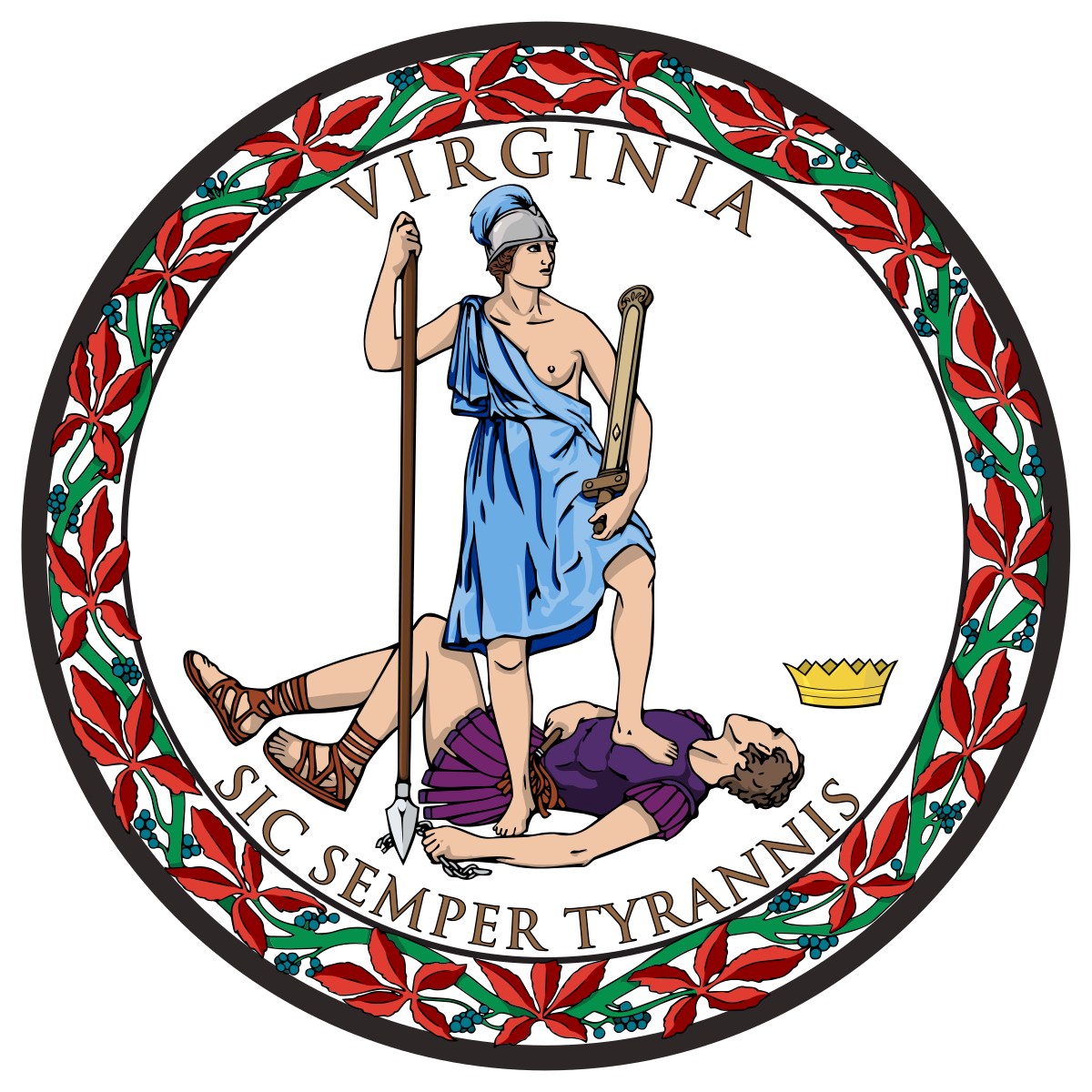
The seal shows the female figure of Virtue standing victorious over Tyranny, and our motto: “Sic Semper Tyrannis” which means “Thus always to tyrants.” As Wikipedia notes:
This is a derived quote from the famous event in Roman history, attributed to Brutus upon his participation in the slaying of Caesar. (Caesar had been named perpetual dictator of Rome in the same year, and some senators believed he had ambitions to abolish the Roman Republic and establish himself as a monarch.)
President Trump is trying to corrupt our republic, and keep power for himself and his collaborators. This is tyranny. We believe that, as Virginians, no matter how difficult it may be, it is our obligation to stand up to such tyranny. Each of us will vote YES on the referendum — not happily, gleefully, or enthusiastically, but because it’s necessary.
And yet, more than anything, we believe this: how you vote is your decision to make.
Go and vote by April 21st!
We hope you feel and are more informed and empowered to go and vote in the referendum, and to discuss it with your friends and neighbors (and trolls?) online. Here are the key dates for all the upcoming elections in Virginia. The first column here shows all the dates for the referendum, and you can get an overview of it all from our February 17 post.
Remember you can share all our content for free. Invite your friends to subscribe to our feeds, so they are as informed and clear-of-mind as you!
How are YOU thinking about the referendum? Are you going to vote YES, or NO, or are you undecided? What factors are you considering or (if you voted already) what did you consider? Post in our comments and let’s have a conversation about it!
The Supreme Court could have banned gerrymandering nationwide but in all their diminished wisdom allowed individual states to decide.
https://en.wikipedia.org/wiki/Rucho_v._Common_Cause
Also the Democratic championed 2022 John Lewis bill in congress would have banned national gerrymandering but all Republicans voted against it.
https://www.brennancenter.org/our-work/analysis-opinion/road-not-taken-gerrymandering
Brilliant article! Thank you for explaining the rationale behind voting YES clearly as a duty to stand up against a movement which seeks perpetual authority!