

Hello from Wittman Watch HQ! 🇺🇸
Last Thursday we talked about how and why we must reclaim America’s symbols, including our flag.
On Tuesday we opened Wittman Truth File #6: Crime & Public Safety.
Last week we published our one-stop guide to the candidates running to unseat Rob Wittman. Check it out before you vote, and share it with everyone in VA-01!
Early in-person voting for the VA-01 primary is open, and will continue through August 1. (Election Day is August 4.) You’ll find all the info you need to cast your ballot here.
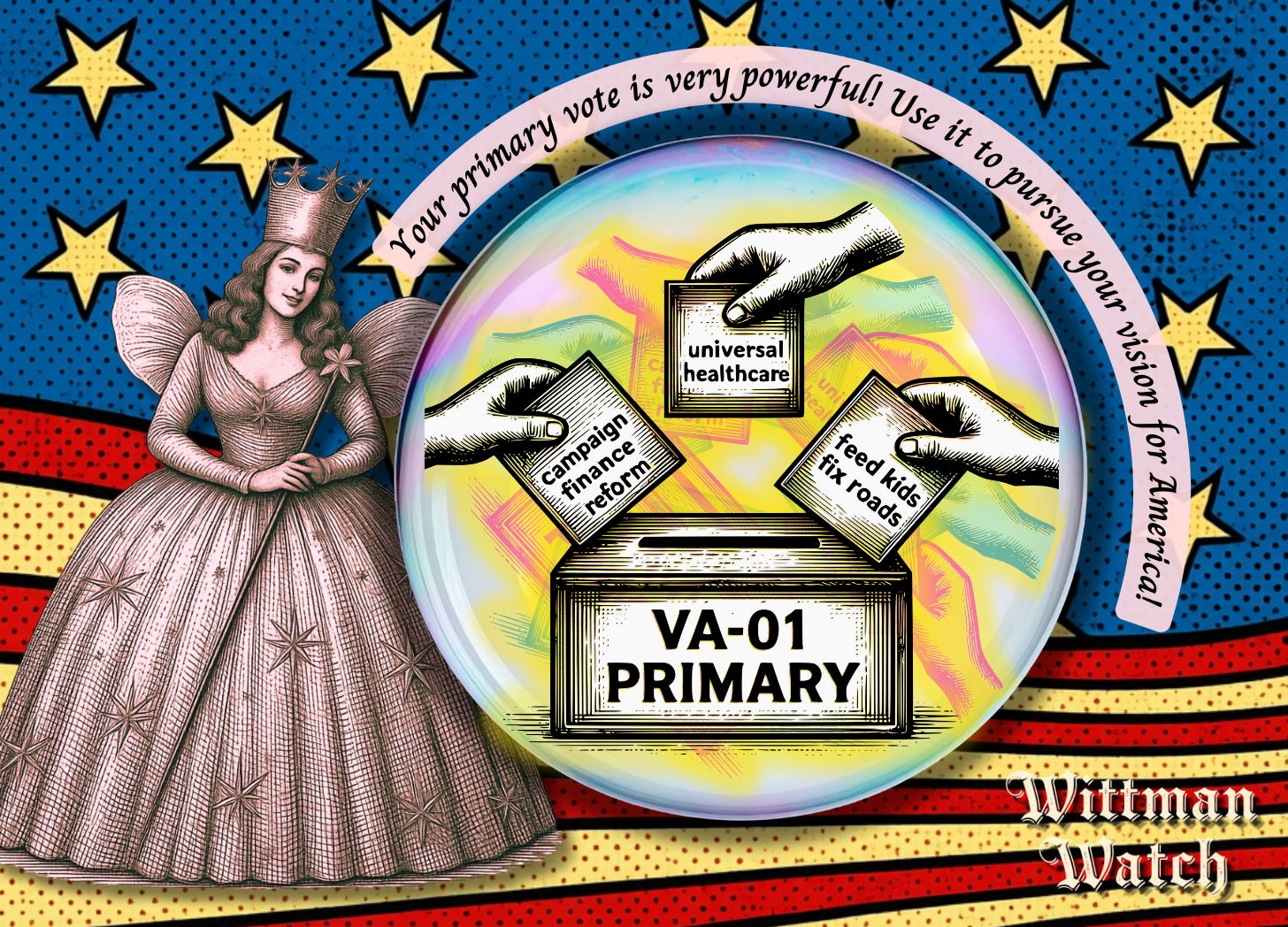
You have an exciting opportunity right now.
The 2026 Congressional Democratic primary is underway in Virginia’s First District. Seven candidates are running to replace Rob Wittman.
First, read our guide to the VA-01 candidates. Then either head to the polls or make your plan to vote!
Key primary voting dates
June 18 – August 1:
Early in-person and absentee voting
Through July 24:
Register to vote; update registration; request mail-in ballot
August 4, 2026:
Election Day
✅ You can register, check your status, or request an absentee ballot at elections.virginia.gov.
What’s the point of a primary?
Let’s talk about primaries. Why do they matter? And what is the power of your individual vote?
Voting is our one core civic responsibility as American citizens. We use our voting superpower to elect representatives of our choosing who will legislate on our behalf and keep our democracy running. It’s our most direct opportunity to participate in our own governance. Here in Virginia, we can flex it every year.
When two or more candidates of the same political party are running for office, a primary is held to determine a nominee. It’s noteworthy that in the U.S., it’s not political parties or national organizations that have the power to nominate candidates — it’s our power as primary voters. To fulfill that responsibility, we need to learn about the candidates and cast a vote for the one who is best aligned with our values and priorities.
In districts with highly partisan maps, primaries matter even more. The relatively low turnout for a primary (compared to a general election) means the primaries tend to hinge upon the most ideologically-driven voters in each party. The outcomes of primaries can shape the trajectory of party platforms, and ultimately even the future of America itself. Our turbulent political climate means the stakes are sky-high. If we don’t show up to vote in a primary, we are allowing our representation to be determined by others who will choose on our behalf, with no consideration of what we care about as individuals.
Know your needs
Imagine standing in front of an ice cream buffet with multiple flavors. Do you base your choice on what the person next to you is going to pick? No; unless you think every flavor is just as good as any other, you base it on your own taste. If you have a peanut allergy, you’re certainly not going to place the same order as the person who gets a peanut butter fudge ice cream cone. If you’re undecided, you can sample the flavors until you find one you like. Not a bad proposition, is it? Choosing a primary candidate operates in a similar way: you base your choice on which candidate appeals the most to you, not anyone else. Their needs for representation are not your needs.
Also, upon discovering that there are lots of ice cream flavors available, you’d never think: “Oh, no, that’s too many choices. What a crowded ice cream buffet! Having choices is bad.” Instead, you’d think: “Yay, having all these options is exactly why I came to this ice cream parlor!”
A strong field of candidates is great for voters. Yes, choosing among them involves some work. We need to juggle information about the candidates, explore the nuanced differences between them, and calculate the risks and benefits of choosing one candidate over the others — especially when their positions on the issues overlap. This process is normal and necessary.
If we forgo our opportunity to vote in a primary, we also forgo the chance to be heard. When it comes to being an informed voter, the “work” of learning the options is a job we’re lucky to have! Essentially, it’s an investment in your future. If you love the idea of, say, affordable healthcare, then a few minutes of your time to learn who will make it happen is well worth the effort.
Have you ever felt like your vote didn’t matter in the face of overwhelming political chaos? You’re not alone. One voter sat out several election cycles because she worried her vote wouldn’t make a difference, until she had a realization:
“If you don’t vote, then you shouldn’t be able to say that you’re mad about what’s going on…That’s what I tell myself, too.”
If you still think your vote doesn’t matter, think again; there are plenty of examples of elections being decided by a small number of votes — or being so close they have to be decided by a coin toss. A single vote seems like such a small thing, but history shows it can have an impact. And of course, we know that a lot of individual votes put together can have a massive impact.
What to consider… and what not to consider
Primaries are exciting because they give us the chance to pick a candidate who best aligns with our positions, values, and identities. It’s a chance to support your dream candidate (or the person who comes closest). Figure out which candidate excites you the most, and then vote for that person in the primary.
At this stage, we can ignore factors like endorsements, odds of winning, or campaign budget. Why don’t you need to care about these practicalities? Because a vote for the person you really want accomplishes several goals other than potentially getting that person elected.
First of all, it gives that candidate an accurate sense of how much they’re resonating with voters. So, if they didn’t win this time, they might run again in the future. Conversely, they might not run for office again if their message hasn’t stuck the landing.
Second, your vote in the primary helps channel important data to the general election. Voting for your dream candidate gives the eventual primary winner a strong sense of voters’ priorities and concerns. A smart primary winner will use that information to their advantage in the general election. This can include platform positions, strategies, and messaging.
Some people believe that if voters don’t all coalesce behind one primary candidate, that represents a loss. But that’s not true, because we can’t “lose” a primary; we’re going to elect a nominee no matter what. We have to remember that a primary is not the general election. Voters are entitled to disagree about who’s the ideal candidate (and ideally, they will — perhaps vociferously!), but this is not the place to compromise our most deeply-held values and priorities. Primaries come with the democratic territory. Compromise and coalition come into play after the primary, when we must throw all our support behind the nominee.
If you’re concerned that your preferred candidate doesn’t have enough money, be assured that after the primary ends, the winner will receive state party funding and a deluge of donations. There are many people who will wait to donate until they know who has won the VA-01 Democratic primary. That gives us our best shot at defeating Rob Wittman.
Voting in this primary means voting for the change we need in VA-01 and beyond. We can say goodbye to Wittman and his self-serving ways, and hello to a new representative who will put VA-01 first.
Now: make your plan to vote!
Why do you think primaries matter? What factors matter most to you when choosing your candidate in this election?
To get the full picture on Rob Wittman, subscribe to this Substack (two emails a week, and we’ll never bombard your inbox about anything else) and any of our social media channels: Facebook, Instagram, BlueSky, or Reddit.
“a vote for the person you really want accomplishes several goals other than potentially getting that person elected.”