

“Fiscal hawk” Wittman is fine with $39 TRILLION national debt
We’re stuck with the tab for billionaire tax cuts, new forever wars, and unlimited spending on grift and vanity projects
Hi from Wittman Watch HQ! 👋
Last Thursday we recapped some of the social media highlights of the last few weeks. Wittman posts new things all the time and our rapid-response team picks them apart on Facebook, BlueSky, and Instagram. We also chat there with followers. We love to chat with folks who agree with us and (especially) with folks who don’t. Subscribe to one of our social channels to get the full Wittman Watch picture.
On Tuesday we launched our new series, Wittman Truth Files, with WTF: Affordability up first. This series profiles the gaps between Rob Wittman’s public claims and his voting record on the issues of highest importance to VA-01 voters. They’re great for sharing with friends, neighbors, and anyone you know who might benefit from never voting for Wittman again. (Y’know, everyone.)
Today we’re writing about one of the scariest numbers in the world: the U.S. national debt.
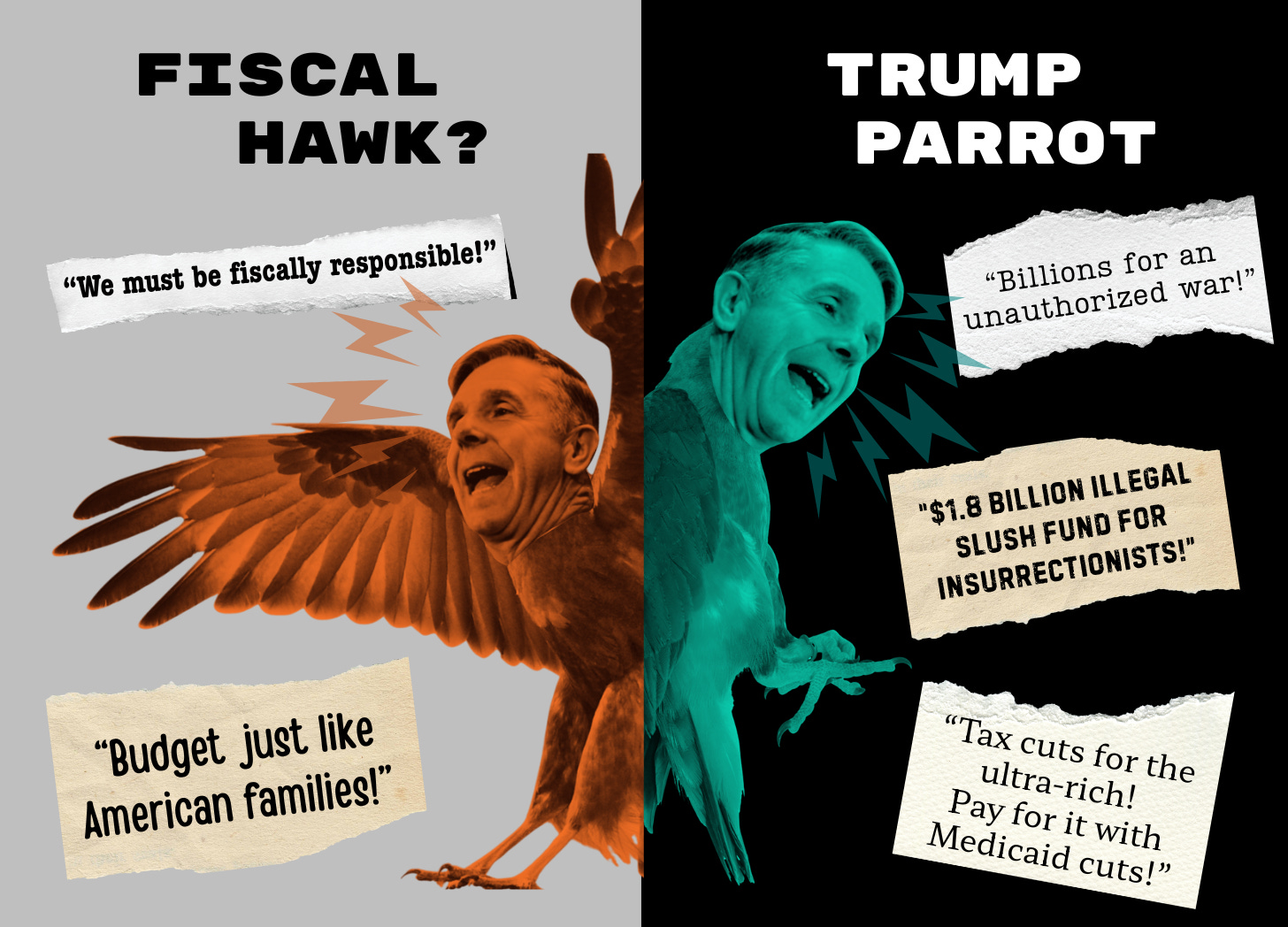
When Rob Wittman became a member of Congress in 2007, the national debt was $9 trillion. He pledged to use “[c]ommon sense conservative principles” and to “prioritize spending and expose the waste, fraud and abuse in Washington.” Here we are, 19 years later, and the national debt is $39 trillion as of May 2026. Has Wittman operated and stood by those good old “common sense conservative principles”? Has he done his best to constrain government spending, and made real efforts to bring down the national debt?
The answer is clear, and the consequences will devastate Virginia’s First District.
Since his first campaign in 2007, “fiscal responsibility” has been the most repeated theme on Wittman’s campaign websites.
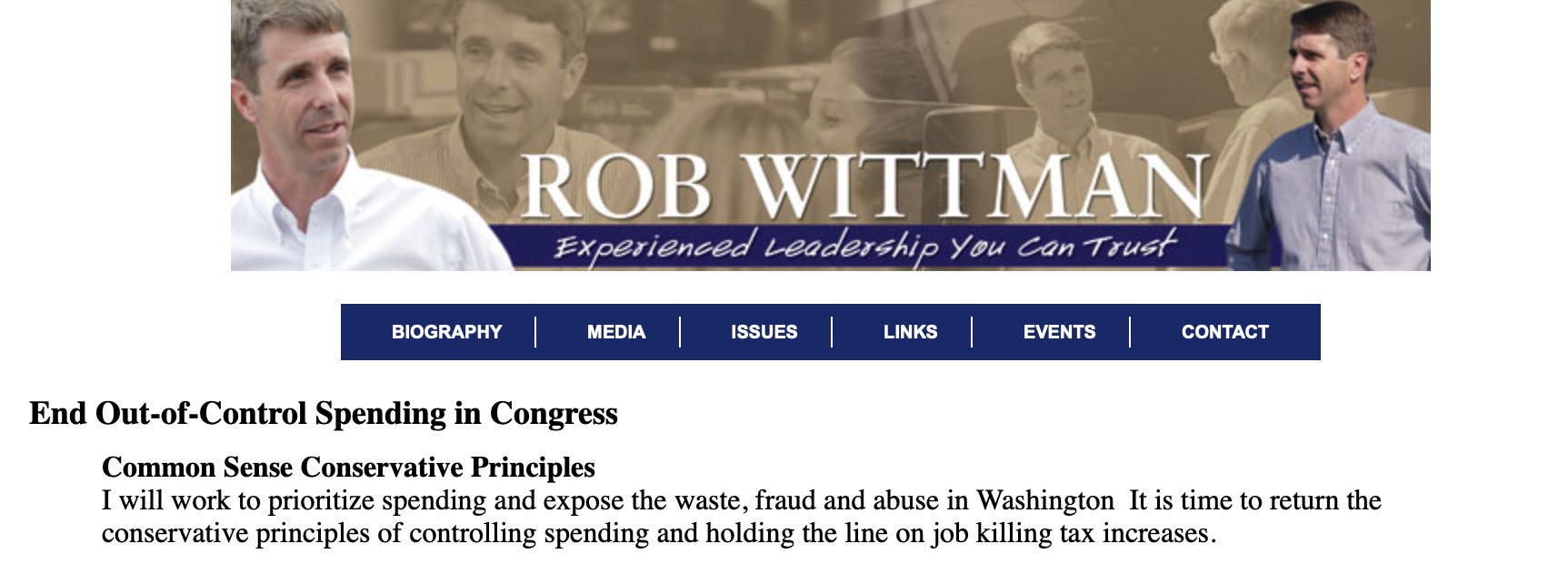
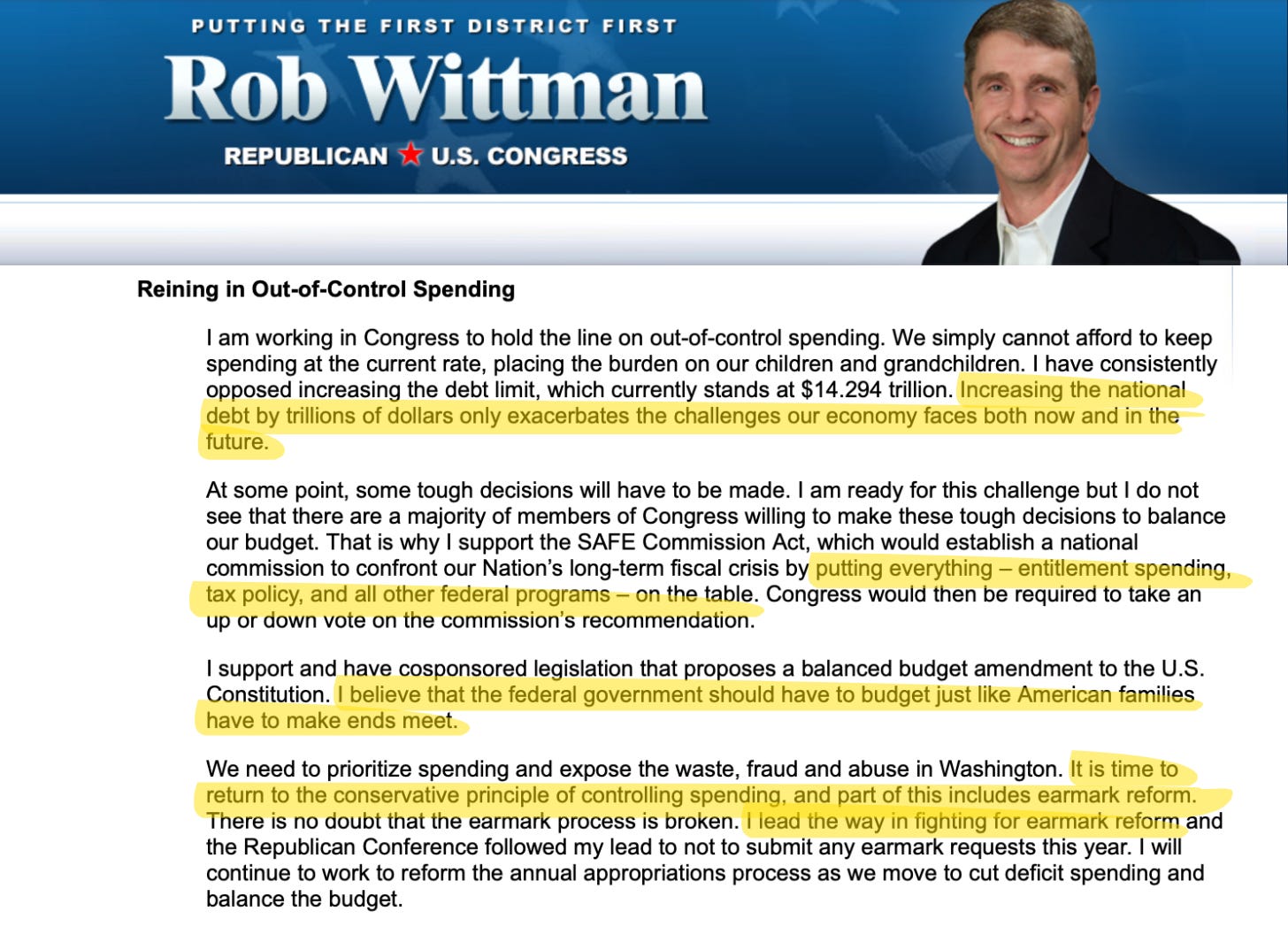
In 2010, when the national debt was $13.6T trillion (not $14.3T as his site claimed at the time), Wittman set out his position clearly:
Opposition to any increase in the debt limit
Support for a national commission on the fiscal crisis, to examine entitlement spending, tax policy, and all federal programs
Support for a constitutional amendment to require a balanced budget
Earmark reform to limit how much members of Congress could add to the budget
Of particular note, Wittman said:
“Increasing the national debt by trillions of dollars only exacerbates the challenges our economy faces both now and in the future.”
— Rob Wittman, 2010
Cycle after cycle, Rob Wittman re-pledged a trio of his own “fiscal hawk” bills: the Stay on Schedule Resolution, the No Budget No Pay Act, and the Inaction Has Consequences Act. The balanced budget amendment never passed. Not one of those three accountability bills became law. And the U.S.’s annual budget, which Wittman pledged to shrink, is running at a $1.9 trillion deficit (loss) every year. The national debt is expanding more rapidly today than it did in 2010.
What led to this, and what was Wittman’s role in it?
Wittman’s actions speak louder than his words
The debt is not attributable to any single member of Congress, but when we look at Wittman’s key votes and actions, we see a very clear pattern: his pledges never match his votes.
Two votes in particular stand out because, between them, they added more than $5 trillion to the national debt – and both happened under President Trump.
December 2017:
Wittman voted for the Tax Cuts and Jobs Act. The nonpartisan Congressional Budget Office estimates it added about $1.9 trillion to the federal deficit over a decade.July 2025:
Wittman voted (twice) for the One Big Beautiful Bill Act. The CBO and the Joint Committee on Taxation put its 10-year price at roughly $3.4 trillion, and more than $4 trillion once interest on the new borrowing is counted.
Whatever happened to that 2010 commitment not to increase the national debt because it would endanger our future and put our economy at risk? What happened to the tenets of fiscal responsibility? Why would Wittman vote against his own credo?
We know that Wittman is perfectly capable of voting against a bill on cost grounds — he opposed the bipartisan 2021 infrastructure law on the grounds that it was too expensive. (Since the bill passed, he’s been happy to claim credit for projects that the bill funded). But when a multi-trillion-dollar deficit increase arrives in the shape of a tax cut, Wittman’s fiscal alarm goes quiet. The CBO’s $1.9 trillion verdict on the 2017 tax cut did not change his vote. The CBO’s $3.4 trillion verdict on the 2025 tax cut did not change his vote. The trigger for Wittman’s fiscal conscience is not the cost to America’s government and taxpayers; it’s the beneficiary. As long as his corporate donors and billionaire class bosses are making out like bandits, his complaints evaporate.
Cloaked in the language of fiscal responsibility
Throughout Wittman’s career in Congress, he has used established “fiscal responsibility” language because it makes traditional conservative voters – who care deeply about constraining budgets and the national debt – feel comfortable, like they’re backing someone solid and responsible. But his votes show he’s doing a bait-and-switch. Wittman’s votes consistently do the opposite of what a fiscally conservative voter (from anywhere on the political spectrum) wants.
The effect on the First District is this: constituents most alarmed by the debt have a representative who reliably votes to enlarge it.
The spending
The gap between Wittman’s fiscal responsibility talk and his actions does not end with the two big tax cuts. Since January 2025, the Trump administration has launched new spending and fiscal maneuvers, and Wittman’s votes or public silences have obediently lined up with the administration.
In June 2025, U.S. forces struck three Iranian nuclear sites without prior congressional authorization, at a cost of around $2 billion. The House defeated a war powers resolution vote on June 26, 212–219; Wittman was among the 219.
Beginning in September 2025, U.S. forces struck 27 boats in the Caribbean and Eastern Pacific, killing roughly 100 people; UN experts have called those strikes extrajudicial executions. The House rejected successive Venezuela war powers resolutions, most recently 211–213. Wittman voted with the administration each time. So far, these lawless operations have cost $4.7 billion.
In 2026, in collaboration with Israeli forces, the U.S. launched further and broader-ranged strikes on Iran. To date, these have cost at least $25 billion, with an ongoing cost of $1 billion per day. Wittman has voted against a war powers resolution, and has suggested there should be a supplemental appropriation for this unauthorized war — even more spending! — going into 2027.
In October 2025, the East Wing was suddenly demolished to make way for a 90,000-square-foot ballroom that Trump had pledged would not cost taxpayers a dime. The estimated cost has now more than quadrupled to $400 million, and a Senate Judiciary reconciliation bill seeks another $1 billion in taxpayer money for security tied to the project. Trump’s proposed self-commemorative 250-foot triumphal arch by Arlington National Cemetery — projected to cost $15 million to $100 million — already has $15 million reserved in the National Endowment for the Humanities’ 2026 budget. Wittman has not said a word against either project. What happened to careful spending and to rooting out waste?
The One Big Beautiful Bill Wittman voted for appropriated roughly $170 billion for immigration enforcement, detention, and border operations, including a gigantic expansion of ICE detention capacity. These funds have been routed largely to private contractors with ties to the administration, and granted without the usual competitive process. The only “spending discipline” in the bill came from gutting Medicaid.
Corruption and self-dealing at our expense
Then there’s the scheme that does not fit any definition of spending — because Congress never voted on it.
On May 18, 2026, Trump dismissed his own $10 billion lawsuit (in which he was both plaintiff and defendant, which is itself disallowed in law) against the IRS — a legally-questionable suit he had filed in January against the government he leads, over a 2019 leak of his tax returns — two days before a federal judge was set to decide whether the case was a genuine legal dispute or “unconstitutional collusion.” That same day, his own Justice Department, with the “settlement”signed by acting Attorney General Todd Blanche (Trump’s former personal criminal defense lawyer) created a $1.776 billion “Anti-Weaponization Fund.” A five-member commission appointed by the Attorney General, with the AG empowered to remove any member, will pay out claims through December 2028 to people the administration designates as victims of “weaponization.” The money comes from the Treasury’s Judgment Fund — taxpayer dollars set aside for legitimate federal settlements. The next day, the deal was expanded to “forever bar” the IRS from auditing Trump’s, his family’s, or his businesses’ pre-2026 tax returns.
This is a $1.8 billion taxpayer-funded slush fund from a self-dealing settlement. Ninety-three House Democrats called the underlying lawsuit collusive in an amicus brief. A career DOJ Civil Division attorney said it amounts to “creating a government program… without going through Congress.”
While some Republicans have expressed dismay at this brazen attempt at Presidential-enabled corruption, which aims to steal $1.8 billion from U.S. taxpayers, Wittman has said nothing. In the days since the announcement, no public statement from him on the fund or the audit waiver appears in the press record. For a congressman who has built a 19-year brand on guarding the public purse, a $1.8 billion taxpayer fund routed around Congress to compensate the administration’s friends — and to shield the president from audit and accountability — absolutely demands comment.
The pattern is obvious
$2B Iran strikes: ✅
$5B Venezuela strikes: ✅
$25Bbn+counting Iran war: ✅
$170 billion in immigration-enforcement expansion: ✅
$400 million ballroom and a $1 billion security cost: 👍
250-foot arch: 👍
$1.8 billion slush fund and a “forever” audit waiver for the president: 🤫
For 19 years, Wittman has painted himself as a paragon of fiscal restraint. In the 17 months since Trump took office again, we can only infer from Wittman’s failure to register a single objection that the rampant unauthorized spending and the corrupt grifting are A-OK with him.
Who pays? WE DO.
And so the debt keeps growing, and the bill will come due – and Wittman expects the people of the First District to pay it.
To make the massive cost of its tax cuts for the ultra-rich look smaller on paper, the One Big Beautiful Bill pairs them with roughly $1 trillion in cuts to Medicaid and hundreds of billions more from food assistance. The CBO projects 10.9 million Americans will lose health coverage. A $50 billion fund for rural hospitals sounds great — but in reality it is no match for the $1T Medicaid cut that lands on rural hospitals hardest. That’s a $950 billion shortfall.
In the Northern Neck, the Middle Peninsula, and other rural parts of our district, the nearest hospital is easily an hour away and already on fragile economic ground. When Wittman assured constituents the bill made “no cuts in Medicare and Medicaid” and that “rural hospitals will get quite an influx of dollars,” he was describing the $50 billion sweetener and deliberately ignoring the enormous, looming trillion-dollar cut.
So consider the deal that Wittman, the First District’s “fiscal hawk,” actually struck. Wittman did not reduce the debt — he added more than $5 trillion to it. And the “savings” in his signature bill did not come from the Washington waste he has campaigned against for 19 years, but from his own constituents’ health coverage and their local hospitals. The spending discipline, when it finally arrived, was real for exactly one group of people — regular Virginians — and absent for everyone else.
A quick summary of the events is helpful. Did Wittman keep his pledges?
The bottom line
The numbers speak for themselves. The deficit and Medicaid figures come from the CBO. The campaign pledges are quoted from Wittman’s own archived websites. The votes are recorded at Congress.gov under Wittman’s name. Check every one, if you’d like.
The brand Rob Wittman’s been peddling since 2007 just doesn’t hold up. For 19 years, he has asked the First District to send him to Washington as a responsible, reliable guardian of the public purse. Voters who answered that call — the ones who are genuinely alarmed by a growing $39 trillion debt — have gotten a congressman whose two largest votes added more than $5 trillion to that debt, who ignores and enables the rampant spending on wars and corrupt slush funds, and whose spending restraint only has consequences for a rural nurse’s patients, not for billionaires and grifters.
A promise that appears only during campaign season, and never in a roll-call vote, is not a principle. It is a slogan designed to buy your vote so Wittman can continue serving his donors, his own interests, and the crooked, corrupt, would-be autocrat with whom he is in league.
We cannot afford Rob Wittman.
What do you think about these numbers and Wittman’s votes? If you once voted for Wittman, are you happy with his work on the national debt? How should the next VA-01 representative address the national debt? Share your thoughts in the comments here or on our social media channels.
To get the full picture on Rob Wittman, subscribe to this Substack (two emails a week, and we’ll never bombard your inbox about anything else) and any of our social media channels: Facebook, Instagram, BlueSky, or Reddit.
Thank you for pointing out that there was never any settlement! Most media outlets are using the word "settlement" because Blanche did, further misleading the public that there might be some kind of legal basis for this massive theft!