

Broken Promises: The Chesapeake Bay
The well-being of the Bay and its workers is worse than when Wittman took office
Greetings from Wittman Watch HQ! 🇺🇸
🗳️ Early in-person voting for the VA-01 primary is open, and will continue through August 1. (Election Day is August 4.) You’ll find all the info you need to cast your ballot here.
🧢 Check out the Wittman Watch store for hats, shirts, yard flags, and accessories that let you show you’re a Wittman Watcher, and share a QR code to our site. As usual, we make $0 — it’s just a stylish, fun way to get friends and neighbors to watch Wittman with you.

Last Thursday we took a look at Wittman’s broken promises on energy.
On Tuesday we opened the Wittman Truth File on immigration. WTFs are great for sharing with friends, neighbors, and anyone you know who might benefit from never voting for Wittman again. (That would be everyone.)
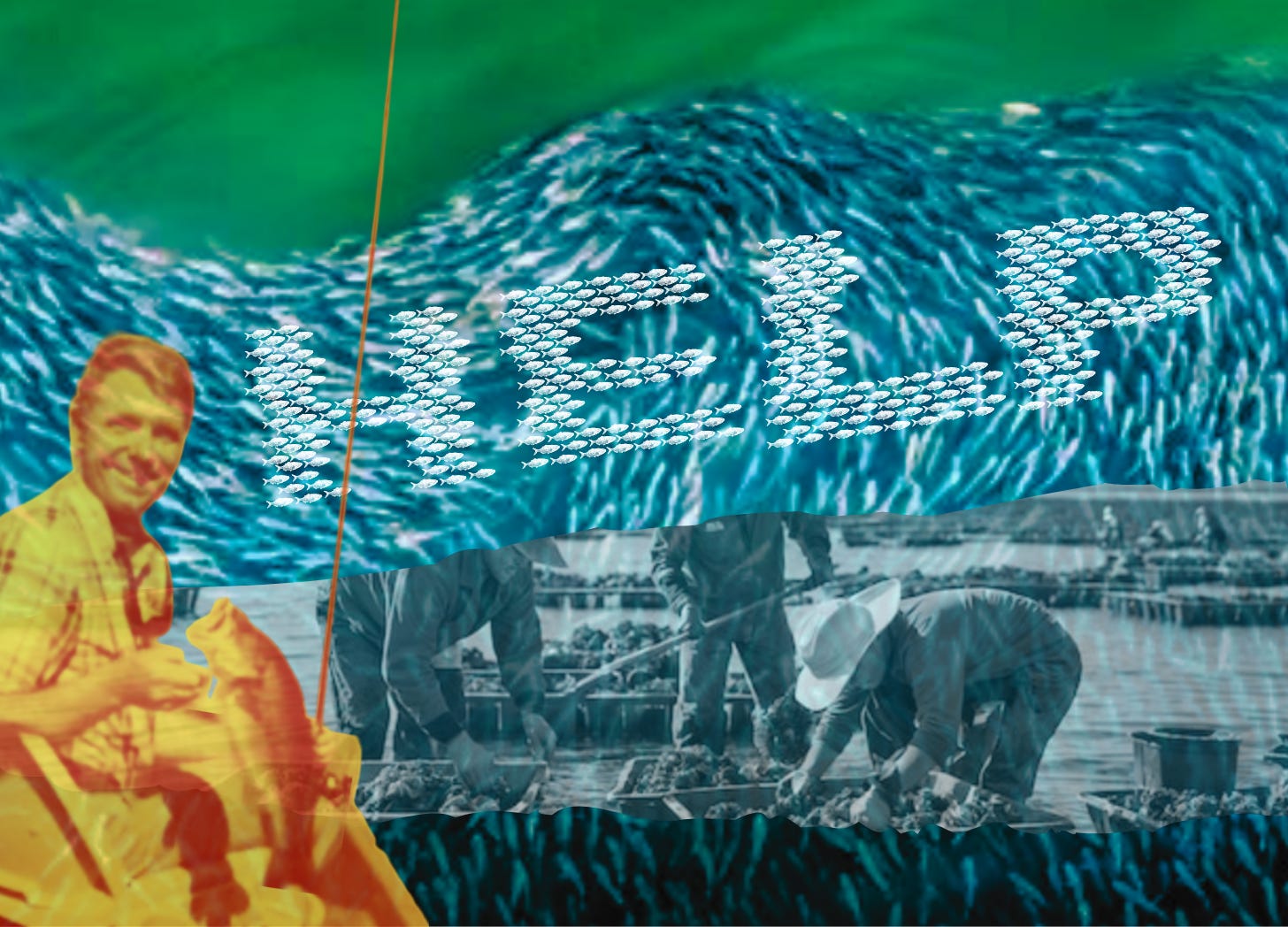
Rob Wittman portrays himself as an expert on the Chesapeake Bay. He earned a Ph.D. and reportedly wrote a 532-page dissertation on what makes shellfish programs work. His own son is a waterman who works in the Bay. Wittman grew up in the Chesapeake watershed, and has built nearly two decades of campaign branding around being the Bay’s man in Washington.
So why has Rob Wittman never once promised to do anything for the people who make their living on the Bay? Since his first campaign in 2007, Wittman’s campaign platforms have never mentioned our watermen, oyster growers, crabbers, aquaculture farmers, processors, or seafood houses. We read every Bay-related pledge he’s ever published and the words “waterman,” “oyster,” “crab,” “aquaculture,” “menhaden,” and “seafood industry” appear a combined ZERO times. The man whose son works on the water campaigned, cycle after cycle, as if the people who make their living on the Bay don’t exist.
Campaign promises aside, what has Wittman attempted or delivered for the health of the Bay and the livelihood of the people who work there? Nothing.
But one metric stands out: after Wittman’s 19 years in office, the Bay’s health is worse than before he started.
His recreation over our livelihoods
Virginia’s seafood industry delivers a $1.1 billion boost to the state economy, supports more than 7,100 jobs, and generates over $168 million in labor income. Virginia ranks number one on the East Coast for oyster production and first on the Atlantic Coast for seafood landings, with landings worth more than $200 million in 2020. Roughly 6,000 Virginians work on the water, including some 2,866 licensed watermen – including Wittman’s own son.
A huge share of that economy lives in VA-01. The Northern Neck, the Middle Peninsula, the rivers feeding the Bay — these are Wittman’s district. When he talks, as he so often does, about the Bay as an “economic driver,” he is describing the work of people to whom he has never shown support.
Compare that silence to what he does promise. His platforms find room for the recreational version of the Bay — for “hunting, fishing, and enjoying the natural beauty” (his own hobby, evidenced by the dead fish that adorn his DC office’s walls), for “tourists, sportsmen and women, and conservationists.” The Bay as a place to play, yes. The Bay as a place to work? Not a word.
The fight in his own backyard
Want to see what that silence costs? Look at Reedville, on the far tip of the Northern Neck — squarely in VA-01.
Reedville is home to Omega Protein, now a subsidiary of the Canadian conglomerate Cooke Inc., which runs the East Coast’s last industrial menhaden “reduction” fishery — grinding the small, ecologically critical fish into meal and oil. For years this has been the single most explosive Bay-industry fight in Virginia. One one side: jobs in a rural town. On the other side: the Bay’s small-scale watermen, along with the health of the Bay’s food web, including striped bass and ospreys.
Experts who monitor the health of the Bay are sounding alarms. Menhaden (the fish the small independent watermen rely on) are part of a food pyramid that, because of overfishing, may be collapsing. Virginia’s reported menhaden bait harvest collapsed from 5.4 million pounds in 2019 to under 1 million in 2024, even as the industrial reduction fleet kept pulling out over 100 million pounds a year. An overwhelming 92 percent of Virginia voters, across both parties, want more menhaden left in the Bay. Studies are urgently needed to examine exactly what’s happening to the menhaden population. Livelihoods are at stake.
This is happening in Wittman’s district, to his constituents, over a fish that sits at the center of the Bay’s food web. The congressman wrote a shellfish dissertation and has a waterman son, but his platforms are strangely silent on the issue. You will not find menhaden, Omega Protein, Reedville, or the reduction fishery anywhere in 19 years of his stated Bay agenda.
Wittman’s silence is a choice. And it is a choice that leaves both the workers and the Bay without their most credentialed and potentially most powerful advocate.
One law, zero reduction in pollution
So what did Wittman promise on the Bay — and did he deliver it?
For fifteen years, essentially his entire Bay platform has rested on a single piece of legislation: the Chesapeake Bay Accountability and Recovery Act. He first introduced a version in 2009, and a companion bill finally became law in December 2014, passing the House 416–0. We must give credit where it is due; that is a real, bipartisan law with Wittman’s name on it, and passing anything 416–0 in Washington is no small thing.
But read the fine print his own press shop will never highlight. CBARA is a budget-transparency measure. It requires the federal government to publish a “crosscut budget” tracking Bay spending across agencies, and it created an Independent Evaluator to report to Congress. That is all it does. It does not reduce a single pound of nitrogen. It does not cap a single ton of phosphorus. It does not plant one oyster or restore one acre of grass. It is accountability about the funding of the cleanup — not the cleanup itself.
For 19 years, “I cleaned up the Bay” has been the implied promise of the legislation he supported. The real deliverable was a spreadsheet.
The scorecard he doesn’t want you to read
As for the Bay itself: here is where the gap between the branding and the reality becomes impossible to ignore.
In June 2025, the University of Maryland Center for Environmental Science graded the Chesapeake Bay a “C” (50 percent), down from a C+ the year before. Eleven of 15 monitored regions showed declining water quality.
Worse still, 2025 was the deadline (established back in 2010) by which the Bay states were supposed to have their pollution cleaned up. But they blew it, for the THIRD time. Reductions in nitrogen — the pollutant that matters most — reached just 59 percent of the target. In December 2025, regional leaders quietly punted the finish line to 2040.
We should note two things. First, the long-term trend on nitrogen pollution is gently upward, thanks largely to wastewater-plant upgrades and climate change (which, incidentally, Wittman has studiously avoided talking about while also consistently supporting fossil fuel providers). Second, no single member of Congress controls a six-state, 1,000-locality cleanup.
But “the Bay is improving slowly and has missed every deadline” is not what the “CHAMPION OF THE CHESAPEAKE” was supposed to deliver over his 19 years in office. Wittman has been in office for the entire arc of the 2010 cleanup plan, from launch to failure. The health of the Bay he was elected to save has worsened.
What’s more, Wittman voted for measures that have created the Bay’s worsening conditions. Agricultural runoff is the single largest source of nutrient and sediment pollution entering the Chesapeake Bay. The Inflation Reduction Act (H. R. 5376) of 2022 included funds to help farmers mitigate the runoff of nitrogen, phosphorus, and sediment. This is important: for example, nitrogen is the pollutant most responsible for the Bay’s core ailment. Excess nitrogen feeds the algae blooms that decompose and create the low-oxygen “dead zones” that kill fish, crabs, and underwater grasses. Controlling that will help the Bay recover. Wittman voted against it.
The bill passed anyway (thanks to a Democratic Party majority) and was signed into law, and conservation funding began reaching farmers in 2023, with Bay-watershed states like Virginia among the beneficiaries. Then, in July 2025, the “One Big Beautiful Bill” (H. R. 1) that Wittman supported rescinded remaining funds, folded a reduced amount into the USDA budget, and dropped the climate and nutrient-reduction targeting language entirely.
So here’s the short story: Wittman voted against conservation funding for the Bay in 2023; it passed anyway thanks to the Democratic majority in the House; and three years later Wittman voted to cut the remaining funds and remove conservation provisions completely.
Rob Wittman worked to remove conservation funding for the Bay, and succeeded.
He cares more about your vote than the Bay
The Bay’s health is under further threat, and Wittman is at the center of it. The Trump administration is considering opening up waters on Virginia’s coast for commercial seabed mining, to include 2,500 square miles just north of the mouth of the Chesapeake Bay. The proposed operations would churn up the seabed to extract minerals, with impacts to: commercial fisheries and the coastal economy (fish, crab, oyster, clam, and scallop populations); wildlife and their habitats (dolphins, sea turtles, migratory whales, shellfish); coastal resilience and shoreline stability (including storm surges and coastal erosion); and military and space operations (submarines, space flight launches).
In December 2023, Wittman sent a letter to DOD promoting the expansion of deep-sea mining which, he said, would help the US obtain minerals for which we would otherwise be reliant on China. The letter was co-signed by 31 Republican members of Congress. This was not a bipartisan effort or anything approaching a broad consensus; Republican members of Congress, Secretary Howard Lutnick, and others are pushing to allow deep-sea mining, under the pretense of “national security” and certainly to support private profit from our limited, fragile natural resources. And Rob Wittman is at the vanguard of that effort.
So ask yourself this: if Wittman was truly concerned about the health of the Bay, the livelihoods of those who make their living from it, or the wildlife that relies upon it, would he proudly lead a partisan effort to open the Bay up to deep-sea mining operations that will inevitably damage the critical natural resource that so many in our district rely upon? Would he vote against conservation funding for the Bay, twice?
No, he would not. For Rob Wittman, the Bay is simply another lever he can pull to feign effectiveness and win your vote. He may say he cares about the Bay, but his actions show otherwise.
Where he showed up, and where he didn’t
To be clear about his record: Wittman has defended Bay funding. When President Trump tried to zero out the EPA Chesapeake Bay Program in 2017 and again in 2025, the Chesapeake Bay Watershed Task Force co-chairs — Wittman, Bobby Scott (D, VA-03), Sarah Elfreth (D, MD-03), and Andy Harris (R, MD-01) — pushed back, helping to secure $93 million for the program in the 2026 budget.
But defending the budget of a program that is missing its targets is not the same as restoring the Bay. And keeping the lights on at the Bay Program does nothing for the Reedville waterman watching his menhaden harvest collapse, or the oyster grower fighting for reef acreage.
What a real Bay champion would have promised (and delivered)
Here is the maddening part: the tools were right there for Wittman to use. A congressman with Wittman’s expertise and committee seats could have made concrete, deliverable promises to the Bay’s workers and industries — but he never did.
He could have championed dedicated federal money for oyster-reef restoration. (A single adult oyster filters 50 gallons of water a day, cleaning the Bay and growing the harvest at the same time).
He could have pushed federal aquaculture grants and low-interest loans for the watermen-farmers driving Virginia’s shellfish boom.
He could have demanded federal funding for the Bay-specific menhaden science that Virginia’s legislature passed in 2023 but has failed to fund — the study that both conservationists and fisheries managers say is needed to settle the Reedville fight on facts instead of politics.
He could have fought for transition support for the working watermen being squeezed out.
Wittman did none of these. But we know he could have, because someone has: Senator Chris Van Hollen (D-MD) got $2.5 million for Bay menhaden studies inserted into the 2026 partial appropriations package passed in February. Why did it take a Democratic Senator from Maryland to get this done?
Wittman didn’t even try.
The accountability gap
Rob Wittman delivered a transparency law and a sustained defense of Bay funding — genuine, if modest, accomplishments. But on the two things his 19-year brand actually promised — a healthier Bay and a secure future for it — the water tells the story: degraded health, a third blown deadline, and a finish line shoved out to 2040.
And as for the people of the Bay — the watermen, the oyster growers, the seafood families who are this district’s economy — Wittman has not made any sincere attempt to serve their needs.
The Bay’s most credentialed defender has chosen again and again to abdicate his responsibility to the people who make their living from the Bay, and to let the Bay’s health degrade. We deserve a representative who fights for the water and the people who work it.
Read his record yourself — the Chesapeake Bay report card is public, the bills are public. And if you ever see Wittman, ask him the question he’s avoided for 19 years: Congressman, what’s your responsibility to the Bay and its watermen, and how are you living up to it?
We can’t change the past, but we can hold Wittman accountable now and in the future. The best way to accomplish that is to VOTE on November 4 for a representative who will strive to balance VA-01’s needs with our quality of life in transparent, accountable ways. Meet seven options better than Rob Wittman.
To get the full picture on Rob Wittman, subscribe to this Substack (two emails a week, and we’ll never bombard your inbox about anything else) and any of our social media channels: Facebook, Instagram, BlueSky, or Reddit.